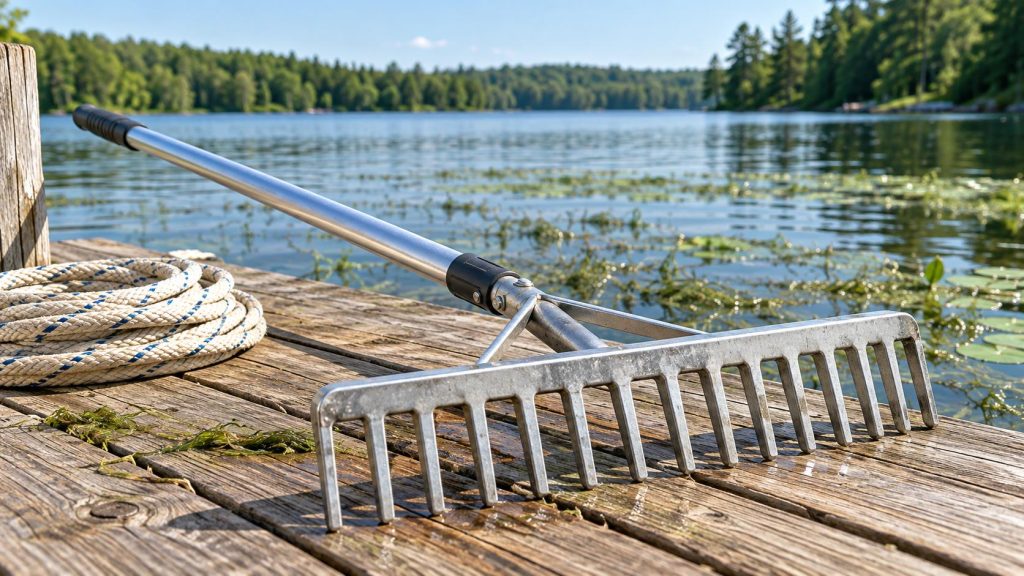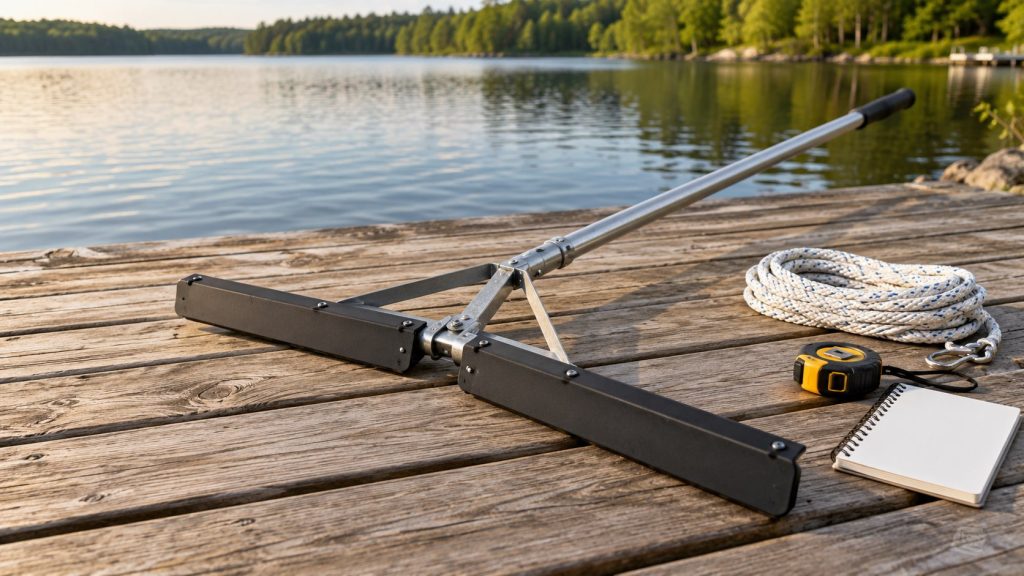
An underwater lake weed cutter must fit the stems, work area, and operator. Compare blade shape, cutting width, and control before choosing a tool for work.
Choosing a cutter by blade width alone leaves out most of the job. A wide head still has to pass through stems, return without hitting an obstacle, and reach a place where you can handle it safely. The useful comparison is between the plant you intend to cut and the motion the tool is designed to make.
This guide focuses on manual underwater cutters. Powered cutters, harvesters, and tools mounted on boats need their own operating instructions and site review. A cutting head that looks similar in a product photo may work in a very different way.
Start with the cutting motion
Ask how the edge meets the plant. Does the tool cut as you pull it toward shore? Does it make a controlled sideways stroke from a handle? Does it need a specific angle to work? Find that answer in the model’s manual before comparing blade shapes. A picture rarely shows the full movement or the clear space needed around it.
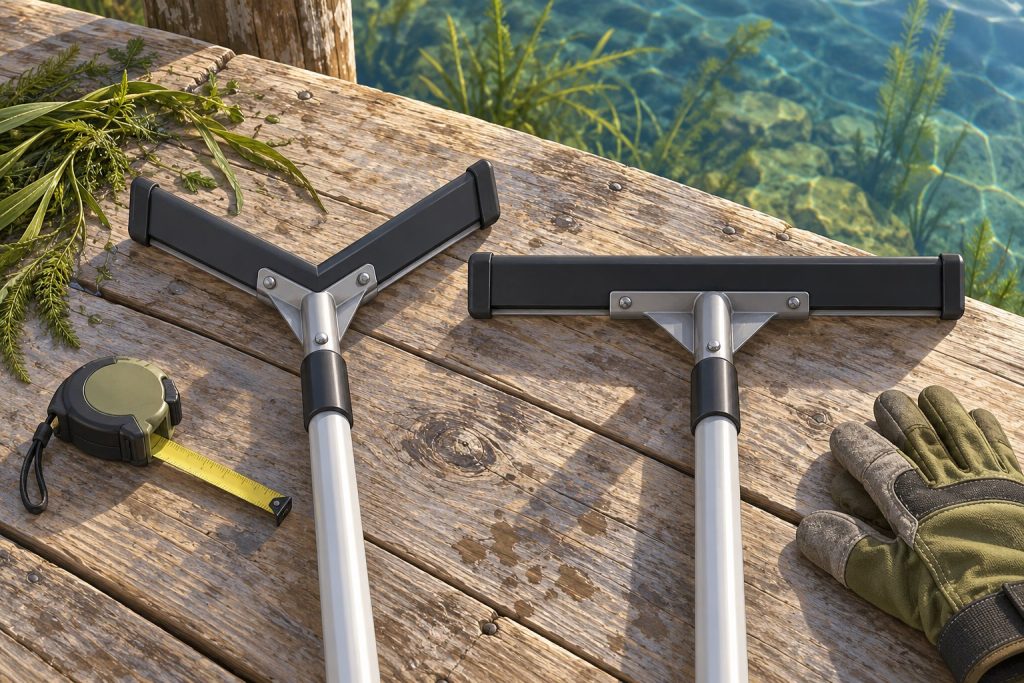
A V-shaped head places two blade arms at an angle. A straight head presents a different outline. Neither shape, by itself, proves that a tool is best for a species. Edge condition, blade angle, stem density, and the operator’s ability to control the stroke all affect the task. Avoid a buying rule that says one outline always cuts better.
Make a simple sketch of the movement from your actual standing point. Include the outward path, working stroke, and return to storage. The return path matters as much as the first cut. A blade that can reach between two objects may still be difficult to bring back without catching them.
Separate cutting width from useful coverage
Advertised width describes the head, not the area you will clear in one uninterrupted pull. Dense stems can bunch, the tool can turn, and the edge may not stay at the intended depth. Overlapping passes may be necessary. These are reasons to ask practical questions, not a basis for inventing a percentage efficiency.
Some adjustable tools explicitly account for density. The Jenlis Weed Razer Pro product manual describes four blade positions and recommends a narrow position for dense vegetation. That is an instruction for that model, not a setting to copy onto an unrelated cutter. Confirm which adjustments your exact tool permits.
For a narrow access lane, compare the head’s widest working position with the space available throughout the stroke. Include side drift and room beside a dock support. Do not plan a pass that only works if the head remains perfectly centered underwater. A smaller approved working width may give you more room to manage the tool.
Width also changes what happens when you retrieve the cutter. Check whether it fits the landing spot without hanging over a walkway. If the manual allows folding for storage, learn when and how the guards must be fitted. Compact storage dimensions are not the same as safe working dimensions.
Match the question to the plant form
| Plant situation | Question to resolve | Reason it matters |
|---|---|---|
| Soft submerged stems | Will the edge cut the identified stems in the intended motion? | A plant may bend or gather instead of being cut cleanly |
| Dense, tangled growth | Does the model allow a narrower setting or smaller pass? | A wide load can reduce control |
| Firm stems rising above water | Is this plant type within the tool’s stated use? | A manual cutter is not automatically suited to every thick stem |
| Rooted floating leaves | Which connected stems are the actual target? | Surface leaves can hide the plant layout |
| Tiny free-floating plants or algae | Is cutting needed at all? | There may be no useful stem-cutting task |
This table is a screening tool, not a species treatment chart. A plant’s name and local management advice still matter. For example, growth that looks like a soft mat may include several plants tangled together. Cutting the whole mat does not let you select only the unwanted species.
If the plant form is still unclear, use the lake weed growth-form guide before choosing a blade. It will help you describe the problem accurately when asking a supplier whether a particular cutter fits.
Soft stems still need a controlled cut
“Soft” does not mean that a tool will pass through a thick bundle without resistance. Several flexible stems can wrap around a head or shift as it moves. A buyer should ask what the manufacturer recommends when the head gathers plants instead of cutting them. An answer that only says to pull harder is not a complete operating plan.
Look for clear instructions about maintaining the edge, setting the head, and clearing a blockage. You need a way to stop and deal with a problem without reaching blindly along a submerged blade. If you cannot see the cutting edge or account for the tool’s position, stop the task and follow the model’s safe recovery procedure.
Keep a simple performance note during permitted use: plant type, approximate density, approved setting, and whether the head cut, gathered, or snagged. That note is more useful than reporting that the cutter “worked poorly.” It helps distinguish a dull edge from a poor match between the plant and the tool.
Firm stems deserve a separate check
A product description may say “aquatic vegetation” without explaining the range of stem sizes it can handle. Ask about the identified plant and its current stage of growth. A young stem and a dense stand of mature stems can present different tasks even when the species name is the same.
Do not use the blade as a lever against a tough stalk or a buried obstruction unless the manual specifically permits that action. Cutting and prying load the tool in different ways. A bent blade, loose joint, or damaged locking part needs repair or replacement, not another trial with more force.
The Canadian Centre for Occupational Health and Safety hand-tool guidance recommends using tools for their intended purpose, checking for defects, and avoiding excessive force. Those principles are especially useful when resistance under water makes it hard to see what is happening.
If a firm-stemmed shoreline plant is outside the tool’s stated use, choose a different plan. Do not convert a manual cutter into a powered attachment to overcome the mismatch. The fact that a rope or handle can be connected to a machine does not make that use approved.
Cut depth is a separate decision from blade shape
A blade’s outline does not tell you how deep it will cut in your location. Water depth, handle angle, rope path, and the tool’s design affect where the edge travels. Ask whether the model offers actual depth control or merely sinks before a pull. These are different kinds of control.
The target should be tied to the access problem. Clearing a route for a paddle is a different goal from removing plants that catch on a ladder. Do not assume that cutting at the lake bottom is always required or desirable. An unseen bottom can contain rock, woody debris, dock hardware, or other hazards.
A simple sketch can mark water depth at a few accessible points and the intended cut zone. Keep the drawing approximate unless you have measured safely. If the plan depends on cutting close to underwater cables, pipes, or structures, get specialist advice rather than testing whether the blade will pass.
A clean cut does not mean lasting removal
The Texas Parks and Wildlife overview of aquatic plant control explains that cut submerged and emergent plants may regrow, requiring repeated work. It also warns that some species, such as hydrilla, can spread from fragments. A blade’s ability to sever a stem is only one part of a management decision.
When comparing tools, separate three claims: it cuts a stem, it creates usable access, and it prevents future growth. The first may be demonstrated in a short video. The second needs a view of the finished area. The third requires evidence over time and cannot be assumed from either of the first two.
Our cutting versus pulling comparison explains the different goals. Use it when the real question is whether reducing plant height will solve your problem or whether another method deserves review.
Include collection in the blade comparison
A cutter that leaves loose plants behind creates a second task. Before buying, describe how those pieces will be collected within the approved work area. The method should fit the size of the pieces, the drift direction, and the place where you can bring them ashore.
The New Mexico State University guide to aquatic weed management stresses collection when using mechanical cutters because loose fragments can survive and establish elsewhere. That concern is a reason to evaluate the complete work cycle rather than judging the tool by cutting speed alone.
For a small trial, record minutes spent cutting and minutes spent gathering. Do not use a trial to exceed the permitted area. If gathering takes much longer than cutting, a wider blade may not save total time. A smaller pass that you can collect fully may fit your workflow better.
Use the cut-plant collection guide to plan that stage. A cutter and a collection tool may be separate purchases, with separate storage and handling needs.
Ask for answers you can check before buying
- Get the exact model’s manual, including the intended plant types and operating motion.
- Confirm working width, allowed adjustments, blade guards, and replacement parts.
- Describe the narrowest space and any underwater structures at the site.
- Ask how to stop, retrieve, and clear the tool if it snags or gathers a heavy bundle.
- Include collection equipment and maintenance supplies in the total cost.
- Confirm the local approval for the planned plants, method, area, and timing.
Keep the answers with the quote or product listing. If the seller cannot explain a critical point, leave it unresolved rather than filling the gap with a review from a different model. Our lake weed cutter buying guide covers the broader purchase decision.
A cutter may be the right match for an approved cutting task; another tool may fit a smaller hands-on project. If the design matches your needs, review the T-Weeder Tool and order one for your permitted shoreline project. Choose by the work you need done, not by an assumed promise that one tool cuts or removes every kind of growth.
Find more practical comparisons in the Lake Weed Tools guides.
Featured image: AI-generated illustration of generic covered cutter heads. It is a design comparison concept, not a product photograph or proof of cutting performance.