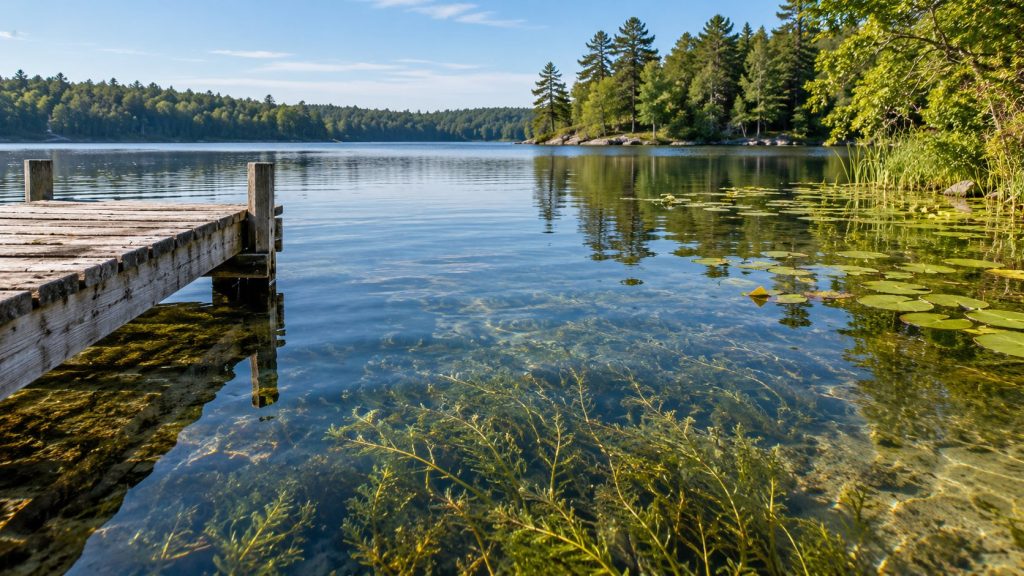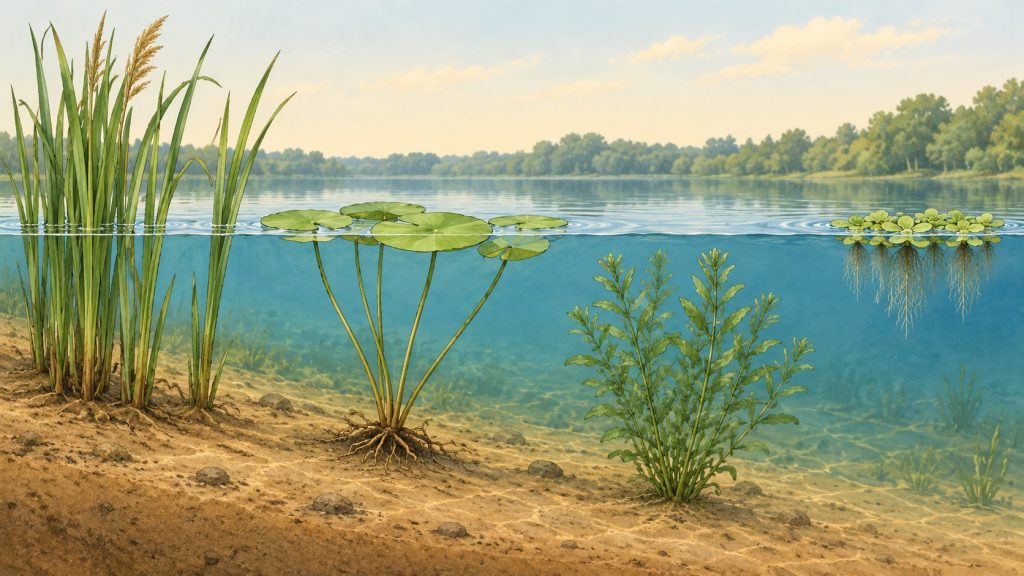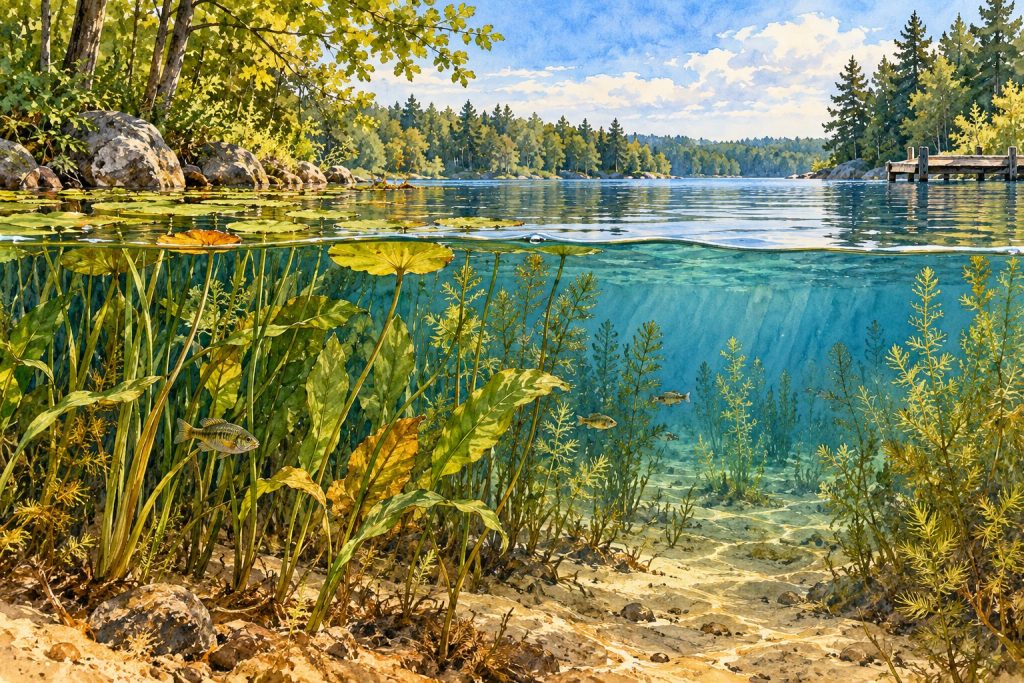
A native lake weed bed can shelter fish, hold sediment, and soften waves. Learn what the plants do before deciding how much space is needed for lake access.
A plant bed can be inconvenient at a ladder and useful to the lake at the same time. Those two facts can guide a better decision than labeling every visible stem a problem. The question is what the bed supports, where it interferes with a real use, and how to keep that use available with limited disturbance.
Native plants are those that occur naturally in the region. Native does not mean that growth can never become dense, and dense does not automatically mean invasive. Confirm the plants before deciding what a patch represents.
Look at a plant bed as living space
A shoreline bed has surfaces, gaps, edges, and layers. Small animals can live among the stems or on the leaves. Fish can use the cover and feed on those animals. Birds may eat plant parts or animals that depend on the bed.
The Minnesota DNR overview of aquatic plant value explains how plants provide fish habitat, food for waterfowl, and living space for small animals. It also describes their role in supporting spawning areas. These benefits are a reason to look beyond whether a patch touches a boat or swimmer.
You do not have to see every animal to recognize the value of the structure. A quiet midday view may show only leaves. Observing from shore at different times can reveal small fish near the edge or birds using the area, but a lack of visible wildlife is not proof that the bed has no role.
Keep the observation simple: note what you see without trying to count a whole fish population. A shoreline photo can document a bed’s shape; it cannot measure all the life it supports.
Roots and stems help hold the bottom in place
The Minnesota DNR natural-buffer guidance describes how aquatic vegetation softens wave action and stabilizes bottom sediment. Plants along the bank also help keep runoff from carrying soil and excess nutrients into the lake. The underwater bed and the shore vegetation are connected parts of the site.
Think about the direction of wind and boat waves at your property. A sheltered plant bed may appear calm partly because of its location and partly because vegetation changes how water moves through it. Removing the visible stems does not automatically create a firmer or cleaner bottom.
If the main complaint is soft sediment, separate that issue from the plant bed. A rake may bring up plants while leaving the underlying sediment condition unchanged. Digging or reshaping the bottom is a different project with different effects and rules.
Avoid treating bare bottom as the only sign of a well-kept shoreline. A usable route through an otherwise intact bed can meet an access need without turning the whole nearshore area into a cleared surface.
Clear water and visible plants can belong together
The Wisconsin DNR aquatic plant overview describes plants as part of a lake’s filtering system. They use nutrients and help keep sediment from being stirred into the water. It also notes that healthy native communities can help resist the establishment of invasive plants, though that is not a guarantee that invasion cannot occur.
A clearer lake can make submerged plants easier to see. It can also allow light to reach farther down. More visible growth is therefore not, by itself, proof that the lake is becoming dirtier. You need to compare observations of water clarity, plant extent, and the kinds of plants present.
Our clear water and plant growth guide explains this relationship. It can help when a family sees a larger-looking bed after the water clears and assumes the only answer is more removal.
Plants are not a substitute for preventing excess runoff. If nutrients keep entering the lake, managing one bed will not resolve the wider source. The runoff and nutrients guide helps organize that separate investigation.
Oxygen benefits need a balanced explanation
Aquatic plants can release oxygen while using sunlight to make food. They also use oxygen for their own life processes. The result changes over the day and with weather, plant density, water movement, and other living things.
The Texas A&M AQUAPLANT dissolved-oxygen guide explains that plants and algae add oxygen through photosynthesis in light and use oxygen through respiration. Oxygen can decline at night. The UF/IFAS guide to plants in Florida lakes also discusses low oxygen in dense beds and the oxygen demand from decaying material.
This means two simple slogans are both misleading: “plants always make the water safer for fish” and “all weeds steal oxygen.” The actual lake conditions matter. A photograph of green plants cannot establish the oxygen level.
If fish are distressed or a major die-off occurs, seek local fisheries or water-quality advice. Do not use a sudden whole-bed removal or treatment as an improvised oxygen response. A large change in living and decaying material can create a different problem.
Describe the access conflict precisely
Before changing a bed, finish this sentence: “The plants prevent us from…” Examples include using a particular ladder, launching a small boat, or reaching an approved mooring. “Seeing open water everywhere” is an appearance preference and should be discussed as such.
Mark the actual conflict on a sketch. A narrow section of growth beside the ladder may be the issue, while the rest of the bed causes no access problem. Keep the size of the desired solution tied to the use rather than to the whole property frontage.
| Observation | Question to ask | Useful next step |
|---|---|---|
| Plants touch the ladder approach | What limited route is needed for entry? | Map that route and confirm allowed work |
| Plants are visible but access works | Is there a practical problem to solve? | Keep a photo record and observe |
| Loose pieces collect after wind | Is the material arriving from elsewhere? | Separate collection from rooted-bed management |
| One unfamiliar plant spreads within a mixed bed | Is it native or an invasive look-alike? | Get an expert identification |
| Water becomes cloudy after disturbance | Is sediment being stirred up? | Pause and reassess the method and bottom conditions |
A clear description makes it easier for an agency, contractor, or family member to understand the goal. It also gives you a stopping point. Once the needed route is usable, a larger cleared area requires its own reason.
Keep patches and edges in the plan
A bed does not have to be treated as one solid block. Note areas of different plant height, open pockets, and existing routes. An access plan can sometimes use a gap that is already present instead of making a new one through the densest growth.
Do not assume every owner should leave the same percentage of plants. The right plan depends on the lake, species, habitat, rules, and use. A number copied from a pond article may not apply to your public lake or shoreline.
Ask whether a proposed route would cut through an important habitat area or a protected plant. If a dock or launch layout is being reconsidered, discuss plant beds early. Moving equipment can have its own approval needs, so include the responsible agency rather than making a quick relocation.
The dock access planning guide can help compare routes while keeping the surrounding bed in view.
Separate native growth from an invasive problem
A healthy native bed can contain an invasive plant, and a dense native species can still interfere with access. These are different situations. Identify the plant that is causing concern and keep its location separate from the rest of the bed.
If an invasive species is suspected, get confirmation and a site-specific plan. Do not use “native plants are useful” as a reason to ignore a new invasive find. Likewise, do not use one invasive stem as a reason to clear all nearby native growth.
Ask a specialist what evidence would show improvement. Is the goal to reduce a confirmed invasive patch, retain native plants, restore one route, or monitor change? Those goals can require different observations and different methods.
Make a small access plan reviewable
Write down the confirmed plants, proposed route, allowed method, timing, and collection arrangements. Add who will do the work and who will decide when the goal has been met. This keeps a weekend cleanup from growing into an undefined project.
Take a before photo from a repeatable point. After permitted work, photograph the same view and note whether access improved. At the next check, record whether the issue is rooted regrowth, drifting material, or a different plant.
Our small-area tracking guide gives a practical structure for that record. Include surrounding vegetation in the photo so you can see what remained as well as what changed.
Do not label one clear photo a long-term success. A route may stay useful, require small follow-up work, or need a different approach. The record helps distinguish those outcomes.
Support the bed from the landward side
Look at how rainwater reaches the shore. A worn footpath, bare soil, roof runoff, or fertilizer use near the lake may deserve attention. Fixing an upland source can be a separate project from managing aquatic plants, but the two plans should not work against each other.
Ask local shoreland or conservation staff about suitable native buffer plants and approved access paths. Do not move aquatic plants from another lake to fill gaps. Planting in or near water may need permissions and species review.
A useful household plan might protect most of the bank vegetation, keep one durable walking route, and maintain one approved water-access area. That plan gives visitors a clear place to go while reducing repeated disturbance elsewhere.
Choose tools for the defined task
If a limited manual task is appropriate, select equipment for the plants, reach, and loads involved. A tool should serve the approved access goal rather than encourage a wider cleared area because it is available.
For a suitable project, review the T-Weeder Tool and order one for your permitted shoreline project. Match the design to the task and keep collection and follow-up in the plan. This is not a recommendation to remove an entire native bed.
Keep one simple question in the record: did the work improve needed access while retaining useful surrounding plants? That question connects the tool choice, habitat value, and day-to-day use of the shoreline.
Explore more Aquatic Plant Identification guides to learn what is growing at your site.
For a practical access plan that leaves useful vegetation in place, see protecting shoreline plants while maintaining access. Start with the narrow route people actually use.
Featured image: AI-generated illustration of a native-style lake plant community and fish habitat. It is a conceptual scene, not a species survey or measured ecological result.