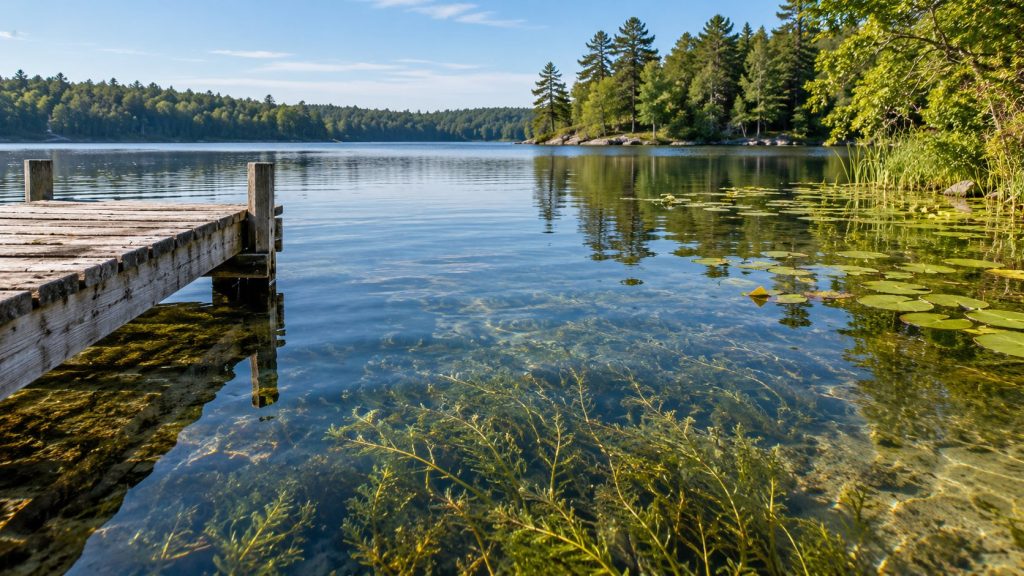
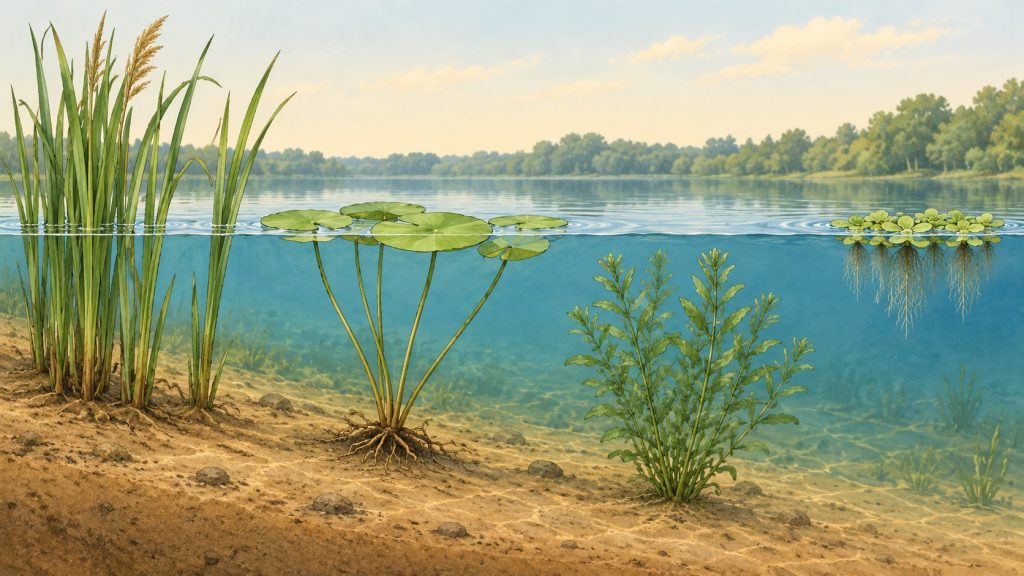
Curly-leaf pondweed and native pondweeds can both have wavy leaves. Check fine edge teeth, leaf attachment and seasonal clues before naming the lake plants.
Looking at a whole green patch from the dock rarely settles the question. Curly-leaf pondweed can grow beside native pondweeds, and several native plants also have wavy leaves. A useful comparison follows one intact stem and checks several details together. The goal is a sound identification that can guide the next decision, whether that means leaving a useful plant bed alone, reporting a possible invasive plant, or planning approved work.
Separate a wavy leaf from a toothed edge
A wave is a bend in the leaf surface. A tooth is a small point along its edge. Think of a folded ribbon compared with the edge of a saw. The two features can appear together, but they describe different things. This difference matters more than the everyday name “curly.”
The Minnesota DNR guide to broad-leaf pondweeds describes native claspingleaf pondweed as having wide, wavy leaves with a broad base around the stem. It lacks the small edge teeth used to distinguish curly-leaf pondweed. A wavy leaf alone is therefore a reason to look closer, not a final answer.
Examine an undamaged leaf edge against a plain light background. Use a hand lens or a clear close-up from a phone. Change the light angle if glare hides the edge. A torn leaf can look jagged, so compare more than one leaf on the same stem. Do not press the leaf flat so hard that you tear it while trying to see the teeth.
Write what you can see in plain language: “small, regular teeth visible on three leaves” is better than “looks invasive.” If you cannot resolve the edge, record that limit. A blurry image should not become a confident species name.
Follow one stem before comparing plants
A handful of lake plants can contain several species. Loose leaves may slide between stems as the bundle is lifted. Start with one connected shoot and trace each leaf back to it. This simple step prevents a common mistake: combining the leaf shape of one plant with the branching pattern of another.
The Minnesota DNR curly-leaf pondweed profile describes leaves attached directly to the stem in an alternate pattern, with a clear middle vein, blunt tips, and serrated edges. Alternate means the leaves occur at different points along the stem rather than as matching pairs at one point. These clues belong together.
Look at the base of a leaf as well as its tip. Does it narrow where it meets the stem? Does its base wrap around the stem? Can you see a separate short stalk? Take notes without forcing a fit to a picture. Two plants may share one feature while differing in another.
A nearby floating leaf may belong to another species. Trace the connection before using it as evidence. Our lake plant growth-form guide helps separate submerged plants, rooted floating-leaf plants, and free-floating growth before you compare species.
Use a comparison sheet, not a one-clue test
| Observation | What it can help you decide | What it cannot settle alone |
|---|---|---|
| Fine, regular teeth along intact edges | Supports closer comparison with curly-leaf pondweed | Whether every stem in a mixed patch is the same species |
| Broad leaf base clasping the stem | Helps compare native claspingleaf pondweed | A name without checking the edge and other features |
| Wavy leaf surface | Shows a useful shape detail | Native versus invasive status |
| Early growth followed by summer decline | Adds a seasonal clue | Proof of treatment success or exact species |
| Small hardened buds on a connected stem | Gives an expert another identifying feature | A reason to move plants between lakes |
Use the sheet to collect observations, not to count votes. Three weak clues do not outweigh one clear mismatch. If the leaf edge does not match the source picture, note the mismatch and ask for help. The best result from a first check may be “pondweed, species uncertain.” That is a useful finding when it prevents the wrong work.
Common names can add confusion. A neighbor may call several broad-leaf plants “cabbage.” Ask which plant they mean and keep a photo with the name. When an expert provides an identification, save the scientific name too. It makes later discussions with a contractor or lake group much clearer.
Young leaves may look less curly
The Wisconsin DNR curly-leaf pondweed guide notes that young plants may have flatter leaves while still showing serrated edges. A photo of a mature, deeply wavy leaf is therefore not the only appearance to expect. The same guide lists Richardson’s pondweed and white-stemmed pondweed among the native look-alikes.
This is another reason to collect several views from one shoot. Photograph a younger leaf near the tip and a more developed leaf farther down. Keep them in the same frame first, then make close-ups. That allows a reviewer to see how the leaves relate rather than guessing whether they came from different plants.
Color is also a weak shortcut. Light, water depth, shadows, and a phone’s settings change the appearance of a plant. A brownish or olive leaf is not automatically curly-leaf pondweed. A bright green one is not automatically native. Put edge shape, attachment and connected structures ahead of color in your notes.
Add the date to every observation
Season is useful context in Minnesota lake weed identification. University of Minnesota Extension’s curly-leaf guide explains that its winter buds, called turions, can sprout in the cold season and support rapid spring growth. A turion is a compact plant bud that can start new growth; it is not simply a seed.
The Minnesota DNR describes a typical pattern of early growth followed by a midsummer dieback. Treat that as a regional pattern, not a calendar promise for every lake. Weather and site conditions vary. A June photo and an August photo can look very different even when you have returned to the same spot.
Keep the date, location, approximate depth, and whether the stems were attached or drifting. A washed-up piece does not prove that the plant is rooted directly in front of your property. Wind and boat traffic can move loose material. Record the find honestly: “floating at east dock” is more useful than claiming a rooted bed you did not see.
If growth disappears after you clear a small area, the timing matters. A natural seasonal decline may overlap with the work. Do not credit the tool alone or assume the plant is gone for good. The guide to lake weed regrowth explains why a clear surface can tell only part of the story.
Do not turn turions into a do-it-yourself test
Compact, hardened structures can help an expert, but a beginner may confuse them with plant tips, debris, or other growth. Photograph the structure while it remains connected to its stem when possible. Include a scale beside it without letting the scale hide its shape.
Finding no obvious buds does not rule out curly-leaf pondweed. You may be looking at the wrong growth stage or at an incomplete piece. Likewise, finding something that resembles a tiny cone is not enough to name the plant. Keep the leaf and stem evidence with that close-up.
Do not scatter pieces to test whether they grow, and do not move a suspected invasive plant to another pond for a clearer look. Ask the receiving agency how to submit a sample before transporting one. For a new Minnesota occurrence, use the reporting contacts linked in the DNR species profile. Start with location notes and clear photographs.
A practical example of a careful comparison
Imagine two bundles beside the same dock. The first has wide leaves that curl in gentle waves. The second has narrower leaves with visible small teeth. Both look brown-green after being out of the water for a few minutes. Calling both bundles curly-leaf pondweed would throw away the most useful difference.
Separate the bundles and give them simple labels, such as A and B. Photograph each whole shoot, then a leaf edge and its attachment. On A, record the broad base and whether teeth are visible. On B, record the regular teeth and leaf arrangement. Send both sets to the same reviewer, explaining that they came from one area.
The reviewer may identify a native plant in A and curly-leaf pondweed in B, or may need better images. Either outcome is better than treating the whole patch as one species. A mixed bed may require a more selective plan. Keep the original labels when adding the expert’s answer so future photos remain easy to match.
Turn an identification into a useful next step
Once the plant is confirmed, decide what problem actually needs attention. Is it blocking one ladder, filling a boat route, or simply visible through clear water? A confirmed name does not by itself mean that every plant should be removed. Native pondweeds can be valuable habitat, and the DNR broad-leaf guide highlights their use by fish.
For suspected curly-leaf pondweed, get local guidance about reporting and management before selecting a method. Minnesota’s DNR species page says invasive plant management in public waters requires a permit. Read our Minnesota lake weed rules starting guide and confirm the requirements for the actual site and work.
A tool choice comes after that decision. For a suitable, permitted shoreline task, review the T-Weeder Tool and order one for your permitted shoreline project. Check the product’s design against the identified plants, access, and collection plan. A purchase is not an identification method or a promise to eliminate curly-leaf pondweed.
Save a final record with the confirmed name, the person or agency that identified it, the date, and the next step. Mark uncertain items as uncertain. This leaves you with a record that another owner, contractor, or lake volunteer can use without repeating the same guesswork.
Browse more aquatic plant identification guides when the next find does not match this comparison.
Featured image: AI-generated illustration of observing lake plants through the seasons. It is conceptual artwork, not a botanical identification photograph.