Sort lake weed types by where they grow: below water, above it, or on the surface. Learn key clues that narrow your search without guessing the exact species.
You do not need a plant name to make a useful first observation. You can start with where the leaves sit, whether the plant seems attached, and how the patch is arranged. Those clues place many lake weed types into a broad growth form.
A growth form describes the way a plant lives in and around water. It does not tell you whether the plant is native, whether it needs management, or which tool to use. Think of it as choosing the right shelf in a field guide before looking for the exact page.
Use four starting groups
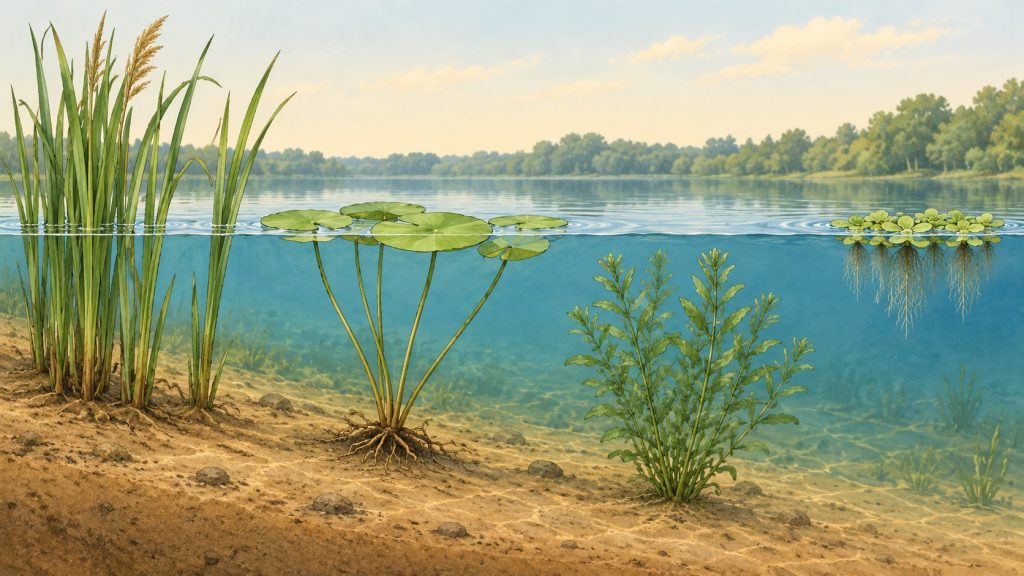
This guide separates plants into submerged, emergent, rooted floating-leaf, and free-floating groups. The UF/IFAS explanation of aquatic plant forms uses these four broad groups and notes that some plants do not fit them neatly. “Submersed” is another word you may see for “submerged.”
- Submerged: Most leaves and stems grow below the water surface.
- Emergent: The plant grows from the bottom and extends into the air.
- Rooted floating-leaf: Leaves lie on the surface and connect to a plant anchored below.
- Free-floating: The plant floats without being anchored in the lake bottom.
Algae need a separate check because some forms resemble leafy plants. We cover that below. Different guides may combine the floating groups or include algae as one of their main categories. Read each guide’s definitions before assuming that its category names match this list.
Submerged plants: look beneath the surface
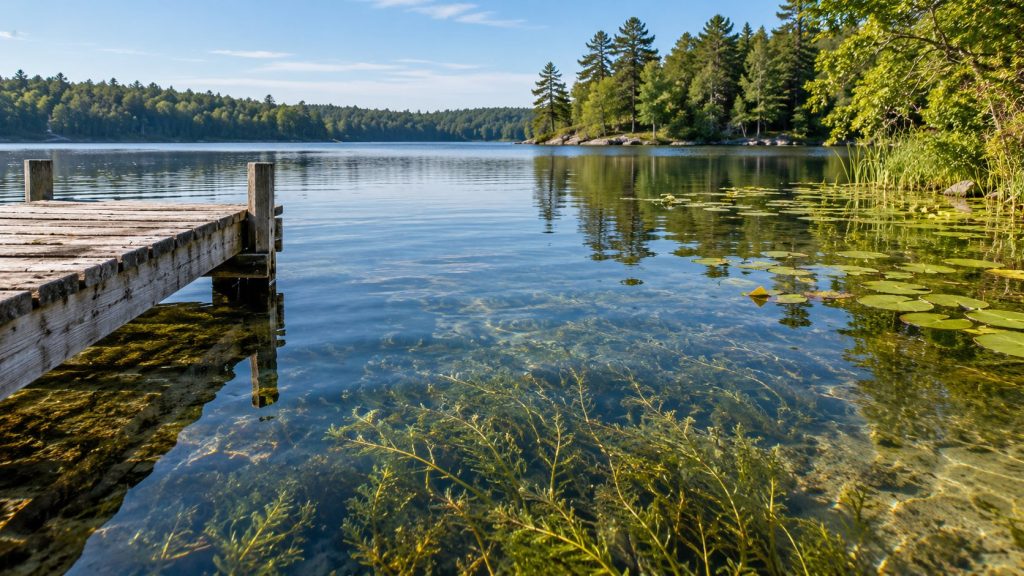
For this group, the main green growth sits underwater. You may see a low meadow, upright stems, or a thick bed that reaches toward the surface. An occasional flower or leaf above the water does not automatically move the whole plant into another group.
The Minnesota DNR guide to where plants grow describes this range of shapes. It also shows why the groups overlap: submerged plants can grow among plants with floating leaves. The edge of one patch is not a clear boundary for every plant below it.
From a dock or another stable position, look at one visible stem at a time. Note whether its leaves are broad, narrow, or finely divided. If the water is too dark or cloudy to see, write that down. A shadow beneath a surface mat is not enough evidence for a leaf shape.
Your first useful label may simply be “submerged plant with narrow leaves.” That is more informative than “seaweed,” and it leaves room for a later correction.
Emergent plants: trace the growth into the air
Emergent plants are rooted in wet ground or beneath shallow water, with stems and leaves rising above the surface. Cattails and bulrushes are familiar examples of this general form. A shoreline view often shows the standing stems more clearly than the base.
As Mississippi State Extension’s plant guide explains, young emergent plants may remain below water before they grow tall enough to rise above it. Some plants can also show different forms during their growth. A single spring photo may not show the mature shape.
For your notes, describe the stand from a distance first. Is it a thin strip along shore, a separate clump, or a broad patch? Then record the visible leaf shape and any flowers or seed heads. You do not need to enter a dense stand to gather the first useful details.
Avoid using “reed” as a final name for every tall shoreline plant. That casual label can hide several different plants that need different identification clues.
Rooted floating-leaf plants: follow the connection
A floating leaf does not prove that the entire plant floats freely. In this group, a stalk connects the leaf to growth anchored in the bottom. Water lilies are a familiar example. The broad leaves can hide the stalks and nearby submerged plants.
Look through a clear gap in the leaves when one is available. Can you see a stalk leading down from a leaf? Does the same group of leaves stay in place while the water moves around it? These observations support a tentative description, although movement alone is not proof of a root.
Do not pull up a plant just to settle that question. Record “attachment not visible” if needed. Ask an identification contact whether a closer image or an authorized sample would help.
A leaf lying on the water may also be a broken piece from another plant. Notice whether it has a cut or torn edge and whether similar leaves are still connected nearby. Keep the loose piece and the growing patch separate in your notes.
Free-floating plants: look at whole small units
True floating plants have no attachment to the lake bottom. The Texas A&M AgriLife AquaPlant identification tool explains that they range from tiny duckweed to much larger plants. Many have roots hanging in the water, so visible roots do not always mean the plant is anchored in sediment.
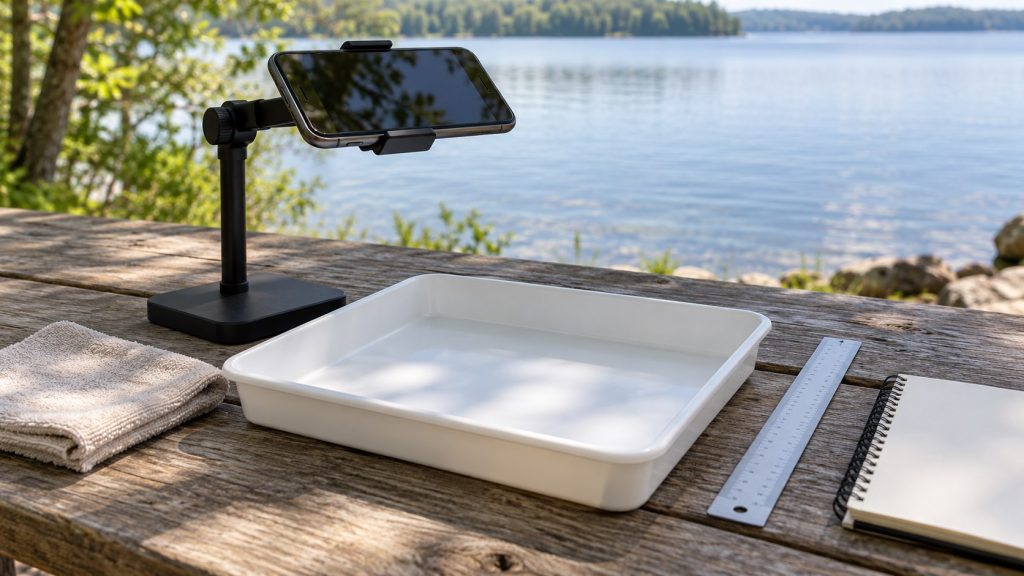
A distant view of a dense surface cover can hide its structure. Look for repeated small units instead of treating the whole green area as one plant. Take a closer photo from a safe position and include a size reference when you can do so without disturbing the patch.
Watch the edge of the cover over time. A change with the breeze can be a useful clue. Still, a floating mat caught against a dock may stay in place, and a detached rooted plant may drift. Use movement together with the plant’s form rather than as a single deciding test.
A floating mat may still connect to shore
Some plants spread out from the bank and form mats on the water. Clemson Extension’s guide to floating plants calls this a trailing growth habit. It separates these mats from both freely floating plants and plants with leaves attached to roots beneath the water.
This is a useful exception to keep in mind when a patch looks like a floating lawn. Look for stems leading back toward the shore. Note whether the mat has a clear edge and whether upright shoots rise from it.
Do not force this observation into a category that fits poorly. “Mat extending from shore; attachment unclear” is a sound field note. It tells the next person what you saw and what still needs checking. An honest uncertain description is more useful than a confident name based on the surface alone.
Check whether the green material is algae
Algae can take several forms. The Texas Parks and Wildlife identification guide describes tiny suspended forms, stringy growth, and large forms such as chara that resemble submerged plants. A green color alone cannot sort them.
Look for visible structure. Are there separate leaf-like units, a branching stem with leaves, fine tangled threads, or no clear parts at all? Record what you can see without reaching into unknown material. A close photograph can help an expert decide which identification path to follow.
If the surface looks like a film or a colored smear and you cannot see plant parts, do not label it duckweed simply because it is green. Keep that observation separate from nearby leafy plants. This growth-form guide does not determine water safety or confirm the type of an algal bloom.
Use a short observation sequence
Start with the whole patch, then move toward detail. This sequence keeps the setting connected to the close-up image.
- First, record the lake name, date, and exact shoreline location.
- Next, note where the main green growth sits: below, on, or above the water.
- Look for a visible connection to the bottom or shore. Mark it unknown if hidden.
- Describe one plant’s leaves and stems rather than the whole tangle.
- Photograph flowers, seed heads, or unusual structures if they are visible.
- Write a tentative growth form and list the clue that led you there.
Do not turn every missing detail into a task that requires entering the water. The first round of notes is meant to guide the next question. It can be enough to show that a specialist needs a better view of the stem or a different season’s growth.
Try the method on three common scenes
These examples show how to use the categories. They are not species diagnoses.
Scene one: small green pieces cover a sheltered dock corner. A close image shows many separate units rather than threads. Your note might read, “Possible small free-floating plant; individual units visible; roots not visible.” The next task is to compare the units with a reliable regional guide.
Scene two: broad leaves rest on the surface and stalks lead down through clear water. Your note can say, “Rooted floating-leaf growth form appears likely.” You still need the leaf shape, stalk details, and any flowers to narrow the name.
Scene three: a dense underwater bed has fine leaves, with a few pieces caught near shore. Describe the growing bed as submerged and the loose pieces as fragments. Do not call the species free-floating merely because part of it broke loose.
Keep mixed patches separate in your notes
A single dockside photo can contain several growth forms. Make a small sketch and give each patch a simple label, such as A, B, and C. Use those same labels for the close-up photos. This prevents a root photo from one plant being paired with leaves from another.
For each label, keep the tentative group, the visible features, and the unanswered question together. For example: “Patch B: underwater, broad leaves, attached base not visible. Need a clearer stem view.”
If one plant lies across another, avoid pulling the whole mix apart for a photo. Ask the identification contact how to document it. The goal is a clear record, not a large pile of material. Keep original image files so the person helping can zoom in on details.
Move from a group to a species with care
Once the group is clear, use a regional plant guide to compare leaf shape, leaf arrangement, stems, and reproductive parts such as flowers or seeds. Common names can vary, so save the scientific name when an expert confirms it. Also save the date and the name of the guide or contact.
Our lake weed identification guide helps you organize that next step. It is reasonable to keep two possible names open until the deciding feature is visible. An image search result that looks similar is a candidate to check, not confirmation.
Ask a specific question when sending your notes: “Does this appear to be a submerged plant, and which detail would separate these two possible matches?” That is easier to answer than a blurry photo with only “What is this?” attached.
Let the identification guide the next decision
The growth form alone cannot tell you whether to remove a plant. It also cannot tell you that a tool will suit it. A confirmed name, the actual access problem, and local guidance should shape that choice.
Use the lake weed removal planning guide after the identification step. If the result supports a suitable manual project, review the T-Weeder Tool and order it for your planned access area. Check its current details against the plant and method you intend to use.
For more ways to narrow a match, browse the Aquatic Plant Identification guides. Keep the growth-form note with your photos. It gives each later conversation a clear starting point.
Ready to look more closely at a plant group? Start with grasslike lake plants if you see narrow blades, or compare coontail and watermilfoil leaves if the growth looks finely divided. Keep uncertain species names marked as unconfirmed.
For closer comparisons, explore curly-leaf and native pondweeds, Chara and starry stonewort, water lilies and floating-leaf plants, the value of native plant beds, and freshwater weeds versus seaweed. Use the guides to describe what you see, then seek confirmation when the identity remains uncertain.
Featured image: AI-generated illustration of broad plant growth forms. It is not a species identification chart.