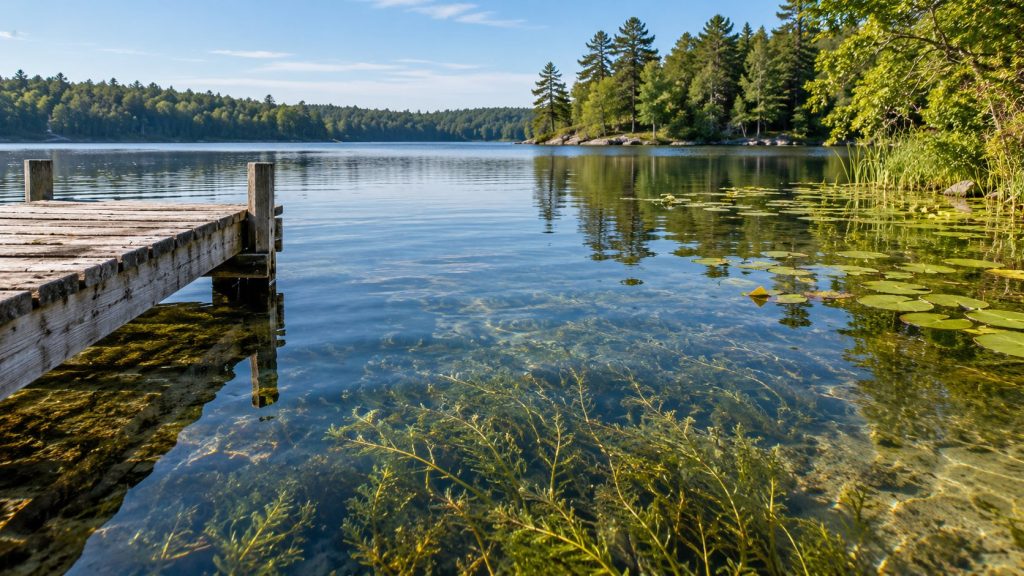
Lake weeds that look like grass may be ribbon-leaf plants, pondweeds, sedges, or rushes. Follow leaves and stems to narrow the choices before taking action.
Looking down from a dock, several plants can resemble a lawn growing underwater. Long leaves sway together and hide the stems below them. Along shore, upright clumps can look just as similar. The shared outline does not mean the plants belong to the same group or need the same treatment.
Use “grass-like” as an observation, not a final name. Start by deciding whether you are looking at one long leaf, a stem carrying many small leaves, or a nearly leafless stalk. Those differences help you choose the right field-guide page and take better photos for an expert.
Start with where the plant grows
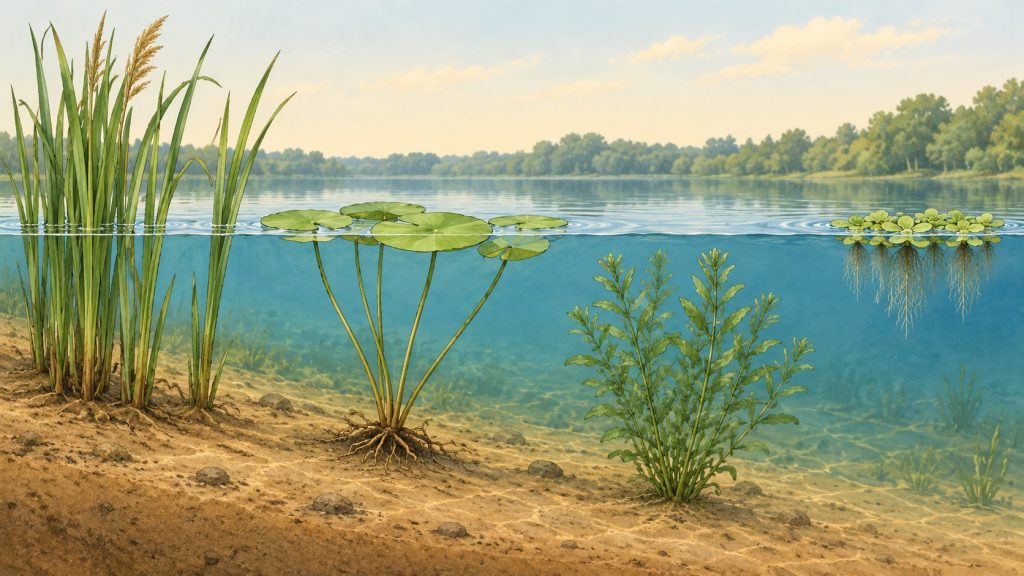
Record whether most of the plant stays underwater, rests on the surface, or stands above it. This broad growth form gives context to the leaf shape. A narrow ribbon under the water deserves a different first comparison from a stiff shoreline stalk with a seedhead.
Water level can complicate the view. A shoreline plant may be flooded, and an underwater leaf may lie on the surface. Look at the whole plant and its setting instead of deciding from the highest piece you can see. Our growth-form field guide explains those broad categories.
Also note whether the material is attached or drifting. A loose ribbon beside your ladder may have arrived from another area. Its position does not show where the plant normally grows. Keep that uncertainty in the description you send for help.
Follow one leaf back to its attachment
Choose one visible piece and follow it toward the base without pulling hard. Does the long green strip stay unbranched? Does it join a stem that carries other leaves? Is the object you thought was a leaf actually a round stalk?
This is often more useful than judging color. Light, water depth, attached algae, and the camera can change the shade of green. The connection between leaf and stem is a physical feature you can document from several angles.
| What you can see | Useful next check | What it does not prove |
|---|---|---|
| Long, unbranched ribbons from near the bottom | Where the ribbons attach at the base | A confirmed wild celery identification |
| Narrow leaves along branching underwater stems | Leaf spacing, veins, and attachment | That all plants in the bed are one pondweed |
| Upright stalks beside the shore | Stem shape, joints, leaves, and flowers | That the plant is a true grass |
| A loose tangled bundle | Whether separate pieces belong together | That the bundle grew where it washed up |
If the base is buried or the plant is out of safe reach, photograph what you can and say what is missing. Do not turn a careful observation task into blind digging. A specialist can tell you which additional feature would be most useful.
Ribbon-like leaves may point toward wild celery
Wild celery, also called eelgrass or tapegrass, is one familiar freshwater example. Minnesota DNR describes wild celery as having long, ribbon-like leaves that remain unbranched and connect near the lake bottom. It can grow among other submerged plants, so a bed may contain several leaf shapes.
Look for a ribbon that continues as one blade rather than a slender stem with many leaves. Photograph its full length if practical, along with the base if visible. The broad pattern can suggest a comparison, but a torn leaf tip or isolated strip is weaker evidence.
DNR also notes the plant’s value as cover and food for wildlife. A native ribbon-leaf bed is not automatically a removal target because it looks untidy from shore. After confirming the plant, define the actual conflict, such as a narrow passage or a ladder approach.
Common names deserve care here. A search for “eelgrass” may bring up plants from saltwater habitats as well as freshwater wild celery. Include the lake’s location and the scientific name shown by a trusted regional source when comparing results.
Fine branching growth may be a narrow-leaf pondweed
Some pondweeds carry many narrow leaves along slender, branching stems. From a distance, a mass of those leaves can look like underwater grass. The important clue is the repeated attachment of separate leaves, rather than one long ribbon running from bottom to tip.
Minnesota DNR’s narrow-leaf pondweed guide describes several plants in this group. Its sago pondweed example has fine, threadlike leaves and a bushy appearance. These plants can become limp when removed from water, so a collapsed handful may hide their normal form.
Use the broad group as a starting point. Do not assume a narrow leaf gives you a species name. Take a close view of several attachment points, the stem shape, and any flower or fruit structures. Keep different-looking stems separate in your photo set.
A useful note might say, “Several thin leaves attach along a branching underwater stem.” That tells an expert what you observed. “Sago pondweed everywhere” skips the identification step and may cause a mixed plant bed to be treated as a single species.
Why pondweed identification may need more detail
Pondweeds are a challenging group even for people who work with plants. UF/IFAS explains that their leaf sizes and shapes vary with conditions, and some species form hybrids. Small structures and reproductive parts may help separate close look-alikes.
One feature used in pondweed identification is the stipule, a small leaf-like structure associated with the leaf base. You do not need to master the term before asking for help. A sharp photo of the attachment area can show a specialist more than a heavily cropped picture of the leaf tip.
Some pondweeds also have floating leaves that look different from their underwater leaves. If you can see two forms connected on the same plant, document that connection. Do not automatically label them as separate species or, in the opposite direction, assume nearby floating leaves belong to the stem in your hand.
Keep a regional guide in view. A Florida guide explains useful features, but its species list is not a complete list for a northern lake. Match location as well as appearance, and ask for confirmation when the details do not fit cleanly.
Water star-grass adds another look-alike
Water star-grass shows why the word “grass” in a name can mislead. Missouri’s water star-grass guide places it in the pickerelweed family. It has branching stems and narrow leaves, with distinctive yellow flowers that rise just above the water when present.
Its leaves lack a well-defined central vein, according to the same guide. That feature can help a trained observer compare it with similar plants. A faint line in a poor phone photo, however, is not enough to make the decision by itself.
If you find a flower, include a close view and a wider frame showing that it belongs to the same stem. Do not pick a nearby flower and place it beside a different plant for the photograph. The connection is evidence; proximity alone is not.
No flower in your photo does not rule the plant out. You may be looking at the wrong season, a damaged stem, or a part of the patch without blooms. Record “no flower seen” instead of “this plant never flowers.”
At the shoreline, compare grasses, sedges, and rushes
True grasses, sedges, and rushes can all form narrow-leaved shoreline growth. Stem shape and joints can help you sort them. A node is a joint-like point on a stem where a leaf attaches. Look for several points along the stalk rather than one damaged or swollen spot.
Illinois Extension’s comparison of grasses, sedges, and rushes describes common patterns: many sedges have triangular stems, rushes often have round stems without nodes, and grasses have visible nodes. It also stresses that exceptions exist.
Treat those patterns as a guide for the next question. They are not a complete species key. Do not decide that a shoreline plant is harmless, invasive, or suitable to remove based only on whether its stem feels round.
Flowers and fruit may become the deciding clues. The Missouri Department of Conservation rush guide notes that separating rush species can require mature fruit viewed under magnification. A broad answer such as “likely a rush” may be the most defensible result from an early-season photo.
Build a short comparison record
A few consistent observations help keep a search focused. Use the same questions for each plant, and leave an item blank if you cannot see it. Guessing at an invisible base or stem shape makes a record look complete while making it less reliable.
- Setting: underwater, floating at the surface, or standing along the shore.
- Main shape: long ribbons, leaves along a stem, or mostly upright stalks.
- Connections: leaves from near the base or repeated along a branching stem.
- Stem: flat, round, angled, jointed, or unclear from the view.
- Extra features: flowers, seedheads, fruit, or none seen.
- Condition: intact, broken, drifting, or mixed with another plant.
For example, “underwater ribbons, no branches visible, base hidden, loose tip nearby” is an honest first record. “Shoreline stalks, rounded, no joints seen, brown flower cluster” is another. Each points an expert toward a useful follow-up without pretending to settle the identity.
Use our plant photo checklist to capture the missing details. A whole-stem view and a scale reference often add more than another wide photograph of the same green patch.
Turn an identification into a site decision
Once someone supports an identification, keep the answer with your original photos and location notes. Ask whether any part remains uncertain. A group-level answer may be enough for monitoring but may not support a species-specific treatment choice.
Once you identify the plant and confirm that manual removal is allowed, check the T-Weeder Tool and order one for your small shoreline project. Match its reach and handling needs to your site first. Plant shape alone does not tell you how firmly it is attached. The roots and hand-pulling guide explains that separate question.
You may decide to leave the bed, monitor it, adjust the access route, or seek a management recommendation. Each choice is stronger when it starts with a supported name and a specific problem. Explore more comparisons in the Aquatic Plant Identification guides.
Featured image: AI-generated illustration of broad leaf and stem patterns. It is not a species identification key or a photograph of a real specimen.