A lake weed mat blocks light at the lake bottom. Learn where bottom barriers fit, what upkeep they need, and which local rules to check before buying any mat.
A mat sounds simple: cover the weeds, leave it in place, and enjoy a clearer area beside the dock. The real decision takes a little more thought. You need to know what is growing, whether a barrier is allowed, how it will stay secure, and who will look after it. Buying the fabric is only one part of the job.
This guide explains bottom barriers for a small access area. It does not give a universal installation recipe. A lake with soft sediment, heavy boat traffic, or protected habitat needs a different plan from a sheltered private pond. Start with the site, then decide whether a mat belongs in that plan.
What a lake weed mat actually does
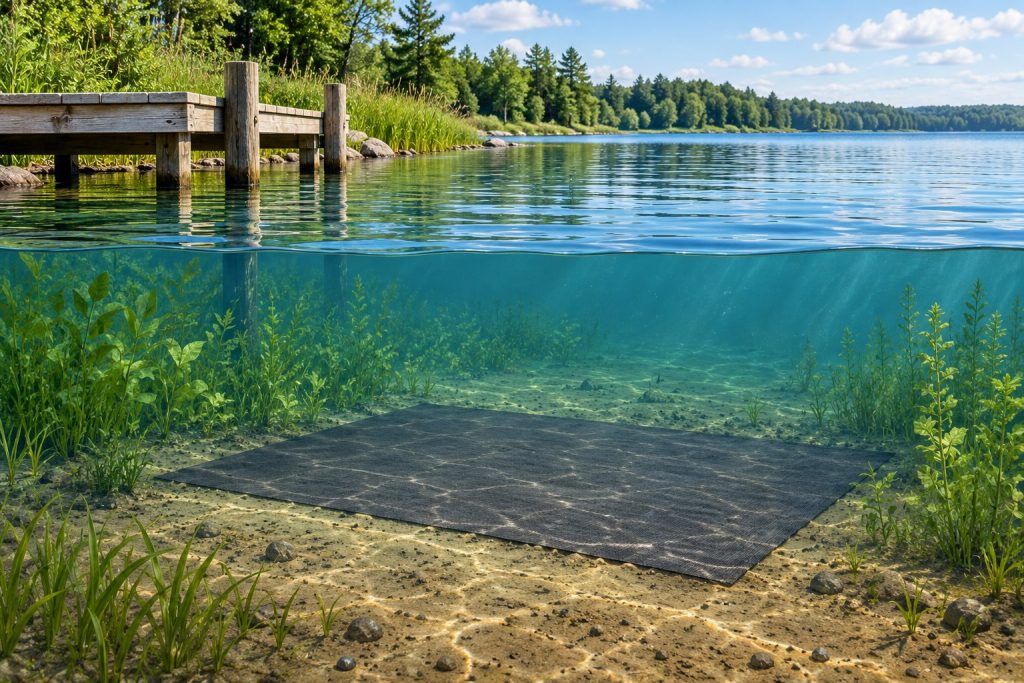
A lake weed mat, also called a bottom barrier or benthic barrier, covers part of the lake bed. It reduces the light available to the plants beneath it and can separate incoming plant fragments from the sediment where they might take root. The NIWA guide to bottom lining explains this mechanism and describes its use for small patches and access areas.
That makes location central to the result. A mat under one part of a dock does not control plants elsewhere in the cove. It does not filter incoming water or collect floating debris. A clear-looking patch above the mat is evidence about that patch, not proof that the larger weed problem has ended.
Think of the mat as a boundary you must manage. Its edges, seams, surface, and anchors all remain part of the project after installation. Ask the seller to explain how each of those parts is checked. An answer that stops at the fabric’s expected life leaves out much of the work you will face.
Identify the problem before comparing mats
Write down what makes the area hard to use. Does rooted growth catch a swimmer’s feet? Do loose stems collect beside the dock? Does a floating layer blow in from the next bay? Those are different problems. Use our lake weed identification guide to gather useful photos before selecting a method.
Photograph the whole patch and a close view of the plant without spreading pieces around the lake. Record its location, approximate depth, and whether it is attached to the bottom. If you suspect an invasive species, ask the local aquatic plant program how to document or handle it before cutting or moving it.
Also separate a plant problem from a bottom problem. If your main complaint is sinking into soft sediment, a weed mat is not automatically the answer. Ask what load the proposed system can support and whether it is intended as a walking surface at all. Do not treat a weed-control product as a substitute for a designed access surface.
Check permission before placing an order
Rules vary enough that a neighbor’s experience is not a reliable shortcut. Minnesota DNR’s aquatic plant regulations list using lake-bottom barriers to destroy or prevent aquatic plant growth among activities that are not allowed. That is more than a routine instruction to apply for a permit. If your property is in Minnesota, start with DNR before pursuing this method.
In Michigan, the state’s invasive species permit guidance says benthic barriers require a permit and directs owners to the inland lakes and streams program. Other states, tribal authorities, and local agencies may use different rules. These examples show why a general online guide cannot approve a specific installation.
When contacting the responsible agency, describe the actual proposal. Include the waterbody, a location map, the planned dimensions, the material, the intended season of use, and how it would be secured and removed. Explain whether you want recreational access or control of a confirmed invasive patch. Ask whether another approval applies to anchors, shoreline access, or work on the bottom.
Keep the written response with your project notes. A seller’s statement that a product is widely used does not establish permission at your property. If a mat is prohibited or the proposed site cannot meet the conditions, change the method rather than buying a smaller mat and assuming it is exempt.
Match the footprint to one clear purpose
Choose a practical goal such as keeping the route from the dock ladder to open water usable. Draw that route on a simple map and mark where people actually enter, turn, and stand. Leave room to record the boundary the agency approves. The goal is a workable access area, not the largest rectangle you can afford.
For a rough shopping example, an area 8 feet wide and 12 feet long has a footprint of 96 square feet. That is a planning calculation, not an approved treatment size or a material order. Seams, overlaps, anchoring, access clearance, and the permitted layout can change the amount of material required. Have the installer reconcile the drawing and the final quote.
Include objects that are easy to miss from shore: dock legs, mooring hardware, water intakes, submerged branches, and the route of a boat propeller. Ask who checks the bottom before installation and what happens if they find an obstruction. Avoid paying for a finished design based only on a photograph from the deck.
Understand the material and anchoring system
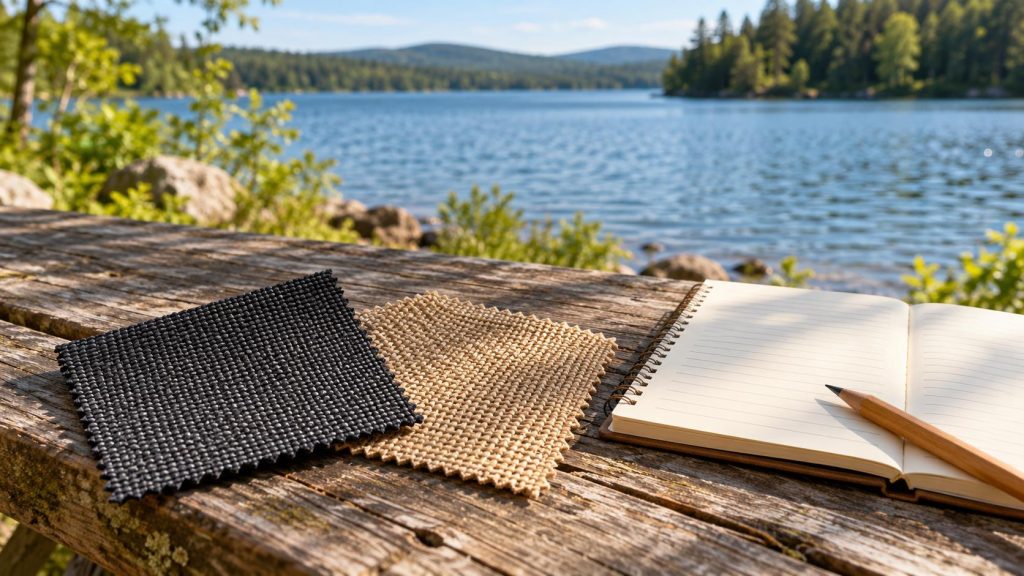
Materials differ in how they block light, release gas, and hold up during use. Texas Parks and Wildlife’s plant-control guidance notes that gas can build beneath a barrier and lift it, and discusses semi-permeable materials as a way to address that issue. Do not assume every sheet sold as a weed mat behaves the same underwater.
Ask for the full product specification, not only thickness or color. Is it designed for aquatic use? What is the anchoring method for this bottom? What routine inspection does the manufacturer require? Who supplies replacement parts? How will the system be located and recovered if visibility is poor? Get answers for the proposed model rather than a similar product.
A heavier fabric is not automatically a complete solution. The installation must account for the site and the approved design. Avoid improvising with loose metal, garden fabric, or an unknown tarp simply because the materials are available. If a contractor recommends an alternative, ask them to identify it in the written scope and confirm that it meets the approval conditions.
Plan installation and upkeep together
Installation can be easier when plant growth is low, but local work windows and the particular project still control timing. Cornell Cooperative Extension’s benthic-barrier overview emphasizes small-area use, secure anchoring, and the practical difficulty of maintenance. It also notes sediment buildup and possible zebra mussel colonization. These are reasons to plan inspection before the mat goes in.
Give one person responsibility for the check schedule. That person should know what a properly installed system looks like, whom to contact when something changes, and how to keep people out of the affected area until a problem is assessed. If you rent out the property or share a dock, responsibility should not depend on whoever happens to visit next.
Useful inspection notes include the date, water level, visibility, edge position, surface condition, loose debris, and whether the intended route remains usable. Take photos from repeatable locations. Record a folded edge or missing component as a repair issue; do not quietly redefine it as normal wear. Follow the installer’s instructions for inspection after storms or other disturbance.
Decide how maintenance will be done safely before accepting a quote. If the water is too deep or visibility too poor for the owner to inspect the system, the budget may need professional visits. Avoid working underwater beyond your training or treating a lake-bed job as an ordinary yard chore. The method must fit the people available to maintain it.
Know what can reduce the result
Sediment can collect on top of a barrier. At that point, new growth may be using the material above the mat rather than proving that light is passing through it. Growth around an edge may reflect a different issue from a tear in the middle. Photograph the location of the problem before deciding that the entire product has failed.
Bottom barriers also affect more than the unwanted plants directly beneath them. Wisconsin DNR’s pond-management guidance explains that barriers can interfere with fish spawning and other wildlife, and can need attention because of silt, ice, lifting, and wear. The absence of an herbicide application does not make the installation free of habitat effects.
Set a review date and decide what success means in ordinary terms. Can the family use the approved entry? How much maintenance did it take? Did the system stay secure? Is growth elsewhere unchanged? A useful review includes labor and condition, not just a photograph taken immediately after installation.
Compare the full cost with a manual option
Request a quote that separates the material, site assessment, approvals, installation, inspection, maintenance, removal, and storage. Ask what the contractor will do if the site is unsuitable on arrival. Check whether a seasonal removal visit is included and whether repairs are billed separately. These questions make two bids easier to compare.
Then estimate a manual approach for the same access goal. Include the time to remove plants, collect fragments, carry material out, and revisit regrowth. Use our lake weed removal planning guide to define that work. Compare one season of complete work with one season of complete work; a mat’s fabric price and a contractor’s finished service are not equivalent offers.
If the approved job is small and hand tools suit the plant and site, compare the T-Weeder Tool and order one for your manual removal project. Check its shape and reach against your work area, then use the lake weed rake buying guide to compare the tasks involved. A tool purchase does not remove the need for plant identification, permission, or collection of loose material.
Leave with a written decision
Before buying, summarize the project on one page: confirmed plant problem, desired access, allowed method, approved footprint, selected product, responsible installer, maintenance owner, and estimated seasonal cost. Add a line for why a mat fits this location. If you cannot explain that fit without repeating a sales claim, there is still a question to resolve.
A lake weed mat can be a practical part of a carefully chosen small-area project where the method is allowed. Its value depends on the site and the upkeep you can provide. For related comparisons, browse the Weed Mats, Rollers and Blowers guides, keeping the same plant, access goal, and maintenance budget in view.
Before choosing a barrier, use our lake weed mat review guide to compare site conditions, anchoring needs, upkeep, and the evidence behind a seller’s photos. Those details make reviews more useful than a star rating alone.
If the problem is drifted material rather than rooted growth, compare bottom mats with floating booms before choosing a barrier. They work in different parts of the water and still need a care plan.
Featured image: AI-generated educational illustration of a bottom barrier in a small lake access area. It is not a photograph of an installed product or an installation plan.