Heavy-duty lake weed rakes need more than wide heads. Compare braces, joints, tooth spacing, and loaded handling to choose strength that fits the shoreline.
Shopping for a heavy-duty rake can turn into a contest of numbers: the widest head, longest teeth, thickest handle, or largest claimed work area. Those numbers describe parts of a tool. They do not tell you how the complete tool will behave with wet vegetation on its far end.
A better comparison starts with the load path. Material catches on the teeth, the head carries it, the connection transfers the force, and your hands control the handle. Strength needs to make sense along that whole path. A large head with an awkward joint or poor fit can be less useful than a smaller design matched to the job.
Translate heavy duty into features you can check
Treat “heavy duty” as an invitation to ask for details. What is reinforced? Which parts can be replaced? What use does the manufacturer describe? Is the tool intended for loose material, lightly attached growth, or another specific task?
Do not assume the phrase defines a standard load rating. Unless a manufacturer supplies a clear rating and the conditions behind it, it is a description rather than a measured limit you can apply at the lake.
| Feature | Ask for | What to remember |
|---|---|---|
| Head width | Overall width and useful collecting span | More width does not guarantee faster complete work |
| Teeth | Length, spacing, shape, and replaceability | The right pattern depends on the material |
| Head connection | Braces, fasteners, and handle attachment | The connection carries the load from the head |
| Assembled weight | Weight at the length and setup you will use | A base model may differ from a full configuration |
| Parts support | Model-specific parts and instructions | Repair options affect useful service life |
Keep a short comparison sheet with those fields. If a listing omits a detail, mark it unknown. Do not fill the gap with a flattering photo or a review that says the rake feels indestructible.
Our rake buying guide covers the general purchase decision. Here, focus on whether added size and reinforcement provide a benefit you can actually use.
Separate head width from useful coverage
A wide head spans more water in one pass, but useful coverage depends on what happens during that pass. The head may tilt, miss part of a patch, gather unevenly, or fill before you complete the intended stroke.
Consider a purely geometric example. A forty-inch head is about sixty-seven percent wider than a twenty-four-inch head. That does not mean it finishes a job sixty-seven percent faster. The wider design may require smaller bites, more unloading, or a different route around obstacles.
Measure the spaces the head must pass through. A gap beside a ladder, boat lift, or dock post can make a wide rake awkward even when open water is nearby. Include the route to storage and the place where you will set the tool down.
If you work around individual patches, the ability to place the head precisely may matter more than its maximum span. If you gather loose material along an open shore, a broader collecting surface may be useful. The task decides which width offers value.
Look closely at the teeth
Teeth are also called tines. Their spacing and shape affect how material enters and stays in the head. Closely spaced teeth may retain finer pieces, while a more open pattern may let some material pass through. Neither arrangement is automatically better for every plant or collection task.
Ask to see a straight-on photo of the head and a side view of the teeth. A dramatic angled product image can make spacing hard to judge. Check whether the stated tooth length is exposed length or includes the part held inside the head.
Long teeth are not proof of complete root removal. Plant attachment varies, and roots or other growth structures may remain below the visible stems. If the main goal is deeper water or a firmer bottom, use the weed-and-muck comparison before choosing a rake.
Find out whether individual teeth can be replaced and whether they are sold for the exact model. The Extreme Max Stake Rake product page, for example, identifies compatible replacement tines. That is a useful support detail to check; it is not independent proof of removal performance.
Follow the load from the head into the handle
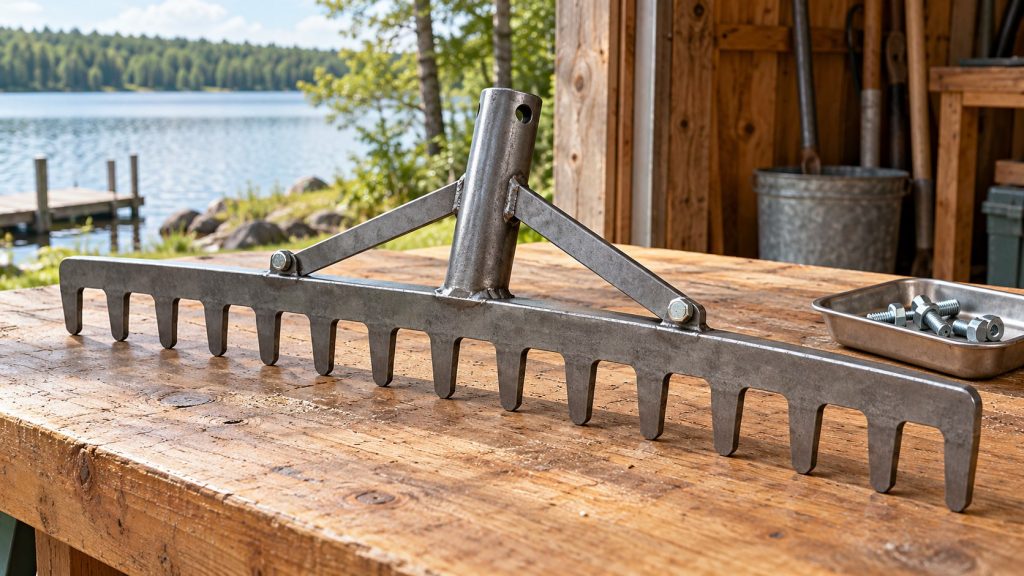
Inspect the point where the head joins the handle. Look at the braces, bolt locations, and the amount of movement the assembly allows. Ask what movement is normal and what would indicate a loose or damaged connection.
The Jenlis Weed Raker manual lists separate head, teeth, support brackets, handle connectors, and other replacement parts. Its assembly instructions show that these pieces work as a system. A buyer can use a parts diagram to understand the design before seeing the tool in person.
Do not judge strength by the head alone. A substantial head can still connect to a worn handle joint. Conversely, a lightweight frame may use bracing to support its intended task. Material names and appearance are incomplete evidence without design details.
Follow the manufacturer’s assembly directions rather than tightening every fastener as hard as possible. The Jenlis manual specifically warns that excessive tightening at one connection can deform the handle. Correct assembly matters as much as the presence of large bolts.
Compare the working weight and balance
Ask for the weight of the complete configuration you plan to use. Include approved extensions, floats, or other fitted parts. A listing may show the base weight while the product photograph shows accessories.
Then consider where that weight sits. A head held far from your hands can feel more demanding than the same mass close to your body. A scale gives a useful number, but it does not describe the effort of guiding the tool at the working angle.
CCOHS guidance on tool design treats weight, balance, grip, task fit, and workplace layout as connected factors. Its examples concern many types of hand tools, so do not turn a general weight recommendation into a universal lake-rake limit.
If possible, handle the empty assembled tool on dry ground with plenty of space. Check whether you can change direction and place the head where intended. This does not reproduce the water load, but it can reveal a poor grip location or awkward balance before purchase.
Remember that wet plants change the comparison
The tool’s dry weight is only part of the load during work. Collected material adds weight and drag, and it may gather on one side. A head that feels easy to lift empty can behave differently when loaded.
Evaluate the complete movement: place the head, draw material toward you, bring it to a collection point, unload, and reset. If the final transfer is difficult, taking a smaller bite may be more useful than adding force.
A wider head can encourage you to collect more than you intended. Decide on a manageable load by how well you control the whole movement, not by how much vegetation can be packed onto the teeth. Stop if the load makes you lean, twist, or brace in an unstable position.
For reach and hand placement, see the long-handle guide. Head size and handle length interact, so compare them together rather than buying each maximum separately.
Do not turn reinforcement into permission to force a snag
Heavy-duty construction does not make a rake a pry bar, winch attachment, or excavation machine. A hidden branch, cable, or rock can create resistance that has little to do with the amount of vegetation.
CCOHS general hand-tool guidance says to use tools for their intended jobs, inspect defects, and avoid excessive force. When a rake stops unexpectedly, reassess the obstruction and follow the manufacturer’s instructions.
Do not attach a hand rake to a vehicle or powered pulling device unless the equipment is specifically designed and authorized for that use. A stronger rope does not establish that the head, joints, and fasteners can accept the changed load.
A useful heavy-duty purchase supports a known task. It should not become a reason to attempt unknown work more aggressively.
Count the complete cycle when judging speed
A short demonstration often shows one satisfying pull. Your shoreline routine includes setup, unloading, carrying material, clearing the teeth, and putting the tool away. Compare those steps as part of the result.
Imagine two suitable rakes on the same permitted task. One collects a larger load but takes longer to clear and carry. The other makes more passes with smaller loads. Either could finish sooner, depending on the plants and landing area. Width alone cannot decide.
If you already own a rake, record a few ordinary visits before upgrading. Note which step takes the most time. If carrying material is the bottleneck, a wider head may only produce a larger pile sooner. If repeated passes over loose material dominate, head width may deserve closer attention.
Use the small-area tracking plan to keep comparisons consistent. Change one main part of the setup at a time when practical, and avoid treating a different day’s conditions as a fair product test.
Read the parts and warranty details
Check whether the seller can identify the model, current manual, and replacement parts. A tool can be sturdy yet difficult to repair if a small connector is unavailable. Ask about teeth, braces, grips, and the parts most exposed to wear.
Read what the warranty covers and excludes. A warranty against manufacturing defects is not a promise that the rake can tolerate any load or misuse. Keep the receipt and assembly instructions with the model number.
- Can the seller provide an exact parts diagram?
- Are wear parts available separately for this model?
- What care is required after use in water?
- Does an extension or accessory change the allowed configuration?
- What happens if a part arrives damaged or does not fit?
- Who handles a warranty request, and what evidence is needed?
These questions help you compare ownership costs without inventing a service-life estimate. A clear support path can be valuable even when two tools have similar dimensions.
Choose strength that serves the shoreline task
For an open collection area, a wider reinforced rake may fit well. For a narrow approach, mixed plants, or a difficult landing, a smaller head may give better placement and handling. Make the choice from the complete task, not the label.
When selective manual work suits your plant and site, review the T-Weeder Tool and order one for your permitted shoreline project. Check the current dimensions and features against your working area, grip needs, and collection route.
Keep the purchase decision simple: enough reach, a useful head, sound connections, manageable loads, and available support. Explore more comparisons in the Lake Weed Tools guides.
To turn these comparisons into a specific purchase decision, use choosing a tool for a small access area. Start with the route, plant, reach, and cleanup needs.
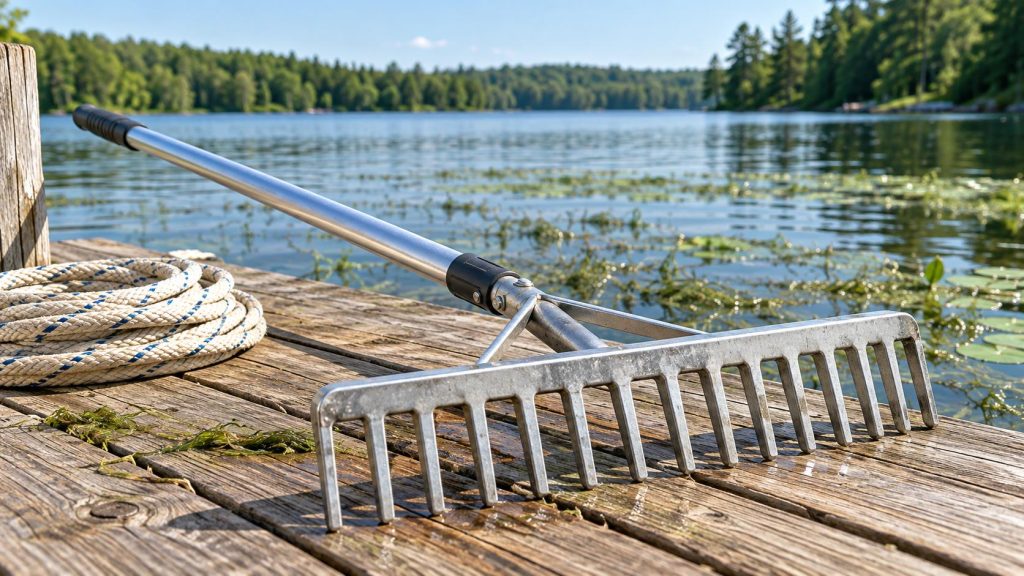
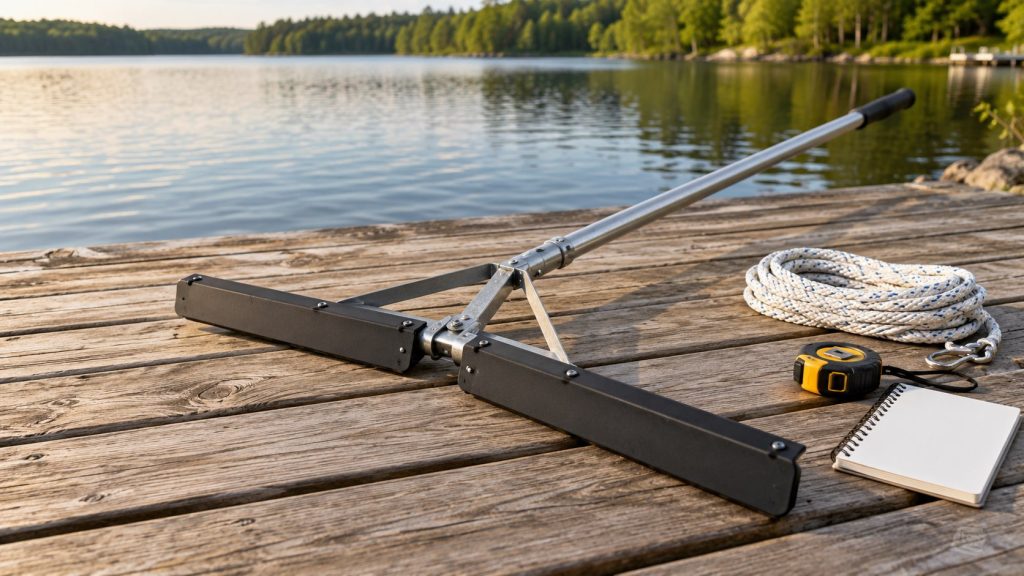
Featured image: AI-generated illustration of generic rake components. It does not depict a T-Weeder product, a tested model, or a measured strength comparison.