Keep a lake weed maintenance log that supports better choices. Record growth, work, time, costs, and follow-up checks so each visit helps plan the next one.
Remembering a lake season is harder than it seems. One long afternoon can feel like a month of work. A patch may seem new because you did not photograph it last year. A short record gives you something firmer than memory when you plan the next step.
You do not need special software. A notebook, a simple document, or a small spreadsheet can work. The best format is the one you will use after each visit. Focus on the facts that help answer a question, rather than building a form with dozens of empty boxes.
Start with the decision the log should support
Choose a practical question before choosing the fields. You may want to know how often a dock route needs work. You may need to compare contractor visits with the work you handle yourself. Or you may be tracking a patch while waiting for an expert’s identification.
Write that question at the top of the first page. Add the lake, property location, season, and name of the person keeping the log. If more than one household member makes entries, use initials so you know whom to ask about a note.
Give the work area a plain name such as ‘ladder route’ or ‘east side of dock.’ Use that name every time. A stable name prevents two people from recording different places under the vague label ‘beach.’
Keep observations separate from explanations
An observation describes what happened. ‘Stems reached the ladder’s lowest step’ is an observation. ‘Runoff caused faster growth’ is an explanation. You may have a reason to suspect the explanation, but it needs more evidence.
Use separate lines for what you saw and what you think it means. Mark plant names as confirmed or unconfirmed. If an expert identifies a plant later, add the name, source, and date. Keep the original wording so the history stays clear.
For changes between seasons, read why lake weeds can vary from year to year. The log can show a pattern without proving its cause. That distinction makes your notes more useful when a lake specialist reviews them.
Record a few useful facts on every visit
At a minimum, include the date, location, observer, and purpose of the visit. Then record the visible growth, any work done, and the next action. Add photo names if you took pictures. A short entry made the same day is better than a long account written weeks later.
Note conditions that affected what you could see or do. Wind, glare, low water, poor visibility, and a recent storm may matter. You do not need a complete weather report. Write only what helps explain the visit.
Use ‘not checked’ when you did not inspect an area. Use ‘unknown’ when you cannot answer a question. A blank can look like forgotten work. A written limit tells the next reader that the missing detail was recognized.
Pair the log with a simple site sketch
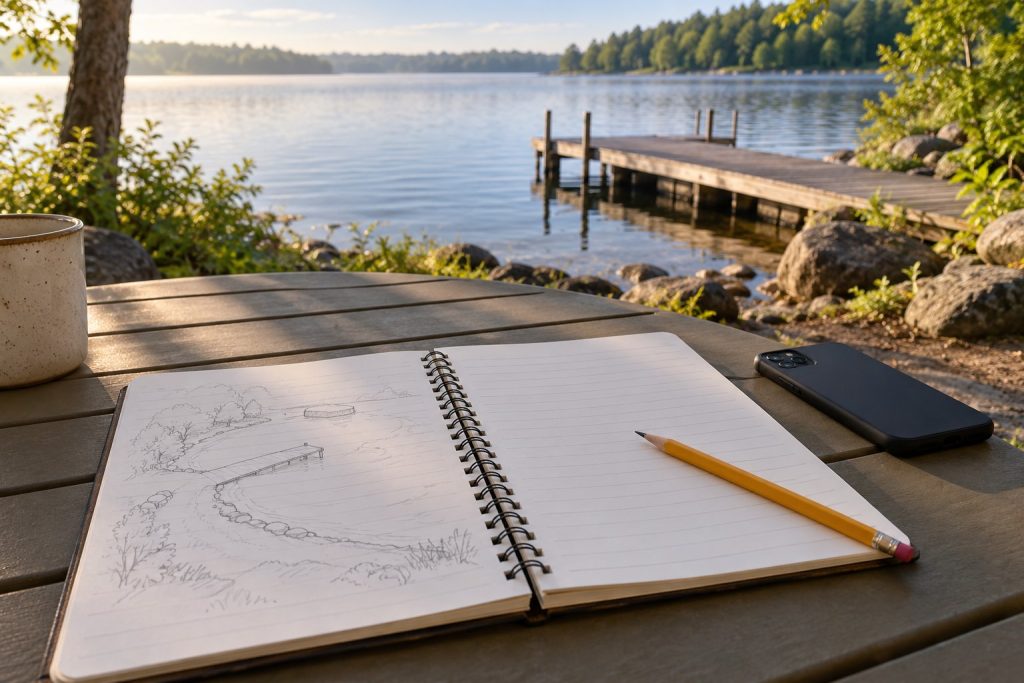
A log explains when something happened. A sketch shows where it happened. Use the same area names on both. Mark a few fixed features, such as dock posts and a shoreline tree, so you can return to the same view.
Our lake weed mapping guide shows a practical way to start. Keep each dated sketch instead of drawing over the only copy. Name photos by date and view, then refer to those names in the entry.
Do not make a rough sketch look more exact than it is. Write ‘estimated’ beside an unmeasured width. If a permitted boundary comes from an approved map, keep that map as its own document. A casual redrawing should not replace the official version.
Give work entries enough detail to explain effort
For a work visit, record the method, area, people involved, and time spent. Split setup, active work, collection, and cleanup when those tasks are large enough to matter. This helps explain why a short removal job can take much longer than expected.
Track both elapsed time and total person time if several people help. In a simple example, two people working for half an hour use one person-hour of labor. That is a way to describe effort, not a price estimate.
Record the stopping point too. You may stop because the planned route is usable, the collection area is full, or conditions become poor. ‘Stopped at agreed boundary’ tells a different story from ‘stopped before finishing.’ Both are useful entries.
Use debris records with honest limits
Write down how removed material was handled and where it went. If you count containers, describe them in a consistent way. A partly filled bag and a tightly packed bin should not quietly become the same unit.
Do not turn a container count into a weight unless you actually weighed the material. Wetness and packing can change the result. A rough count can still help plan carrying and disposal. Label it as a handling estimate.
If disposal or transport requires approval, save the relevant record and note its location. Record cleanup problems as well. Material left beside a path, an unexpected carry distance, or a rejected waste load can change the next work plan.
Keep formal reports in their own place
A household maintenance log is not a substitute for a required treatment record. In Wisconsin, the DNR permit FAQ describes chemical reporting through its ePermitting system, including what to do when no treatment occurred under an NR107 permit. Those are specific reporting duties.
Read your own permit for dates, forms, and who must submit them. Ask a contractor what records it supplies and which duties remain yours. Put the due date in your calendar. A note that says ‘contractor handled it’ is not a copy of the submission.
Keep permits, approved maps, contractor records, invoices, and submission receipts in a project folder. The log can point to those files. This keeps daily notes short while making the supporting documents easy to find.
Do not confuse a log with a plant survey
A few photos from the dock cannot measure the plant community across a lake. The Wisconsin DNR’s plant research resources include standard methods for assessing plant distribution and abundance. Those methods use a planned survey design and structured data.
Similarly, the Minnesota DNR’s invasive plant program describes surveys that map plant distribution and density and help evaluate treatment. A homeowner log can provide helpful background, but it does not replace a survey required for a project.
When you need a broader answer, ask what type of survey is appropriate. Share your dated photos and location notes as background. Let the surveyor decide what additional work is needed. Avoid turning a small number of casual observations into a lakewide percentage.
Use a repeatable check after work
Decide what result you will check before the job begins. For an access route, the question might be whether the planned route is usable at the next visit. For a plant project, the expert may define a different measure and timing.
Record the result in the same terms each time. ‘Ladder route usable without added work’ is clearer than ‘looks good.’ Also note any new issue, such as a loose-pile problem or growth just outside the area.
Our summer maintenance routine can help you fit these checks into normal visits. Do not treat every new stem as a failed project. Compare the result with the goal you wrote down, then decide whether more work is needed.
Use this short entry format
Copy these fields into your notebook: Date and observer. Location. Purpose. Conditions. Growth observed. Plant identity and source. Work completed. Time and helpers. Material handling. Photos. Cost records. Result. Next action and date.
You can shorten the form for an observation-only visit. Keep the date, place, findings, photo reference, and next step. Do not invent a work entry just to fill the form. ‘No work needed’ is a useful result.
Here is an illustrative entry: ‘Morning visit, ladder route. Light wind; bottom visible near shore. Known plant patch remains outside route. No removal today. Photos saved as ladder-view-one and ladder-view-two. Route usable. Recheck during next normal visit.’ This is a sample of clear wording, not a report from a real property.
Review costs without mixing unlike tasks
Attach receipts or record their file names. Keep tools, contractor service, transport, permits, and monitoring separate. Then add them to a seasonal total. Note whether a purchase will serve more than one season.
Do not compare one quick check with a contractor’s survey and removal visit as if they were the same service. Write what each cost covered. Our lake weed removal cost guide helps organize a comparison around the actual scope.
If the records point toward a suitable manual task, review the T-Weeder Tool and order one for your permitted shoreline project. Check the listed features against your site and planned work.
Make corrections and shared records easy to follow
If you discover an error, add a dated correction rather than silently changing the past. For example, note that a photo was taken from the west side, not the east. If you correct a total, preserve the original receipts.
Keep one main copy of the log and back it up. If neighbors share a project, agree on area names and who enters each visit. Share only the details needed for the joint work. Personal billing or contact information may belong in a separate file.
For organized monitoring, use the program’s own training and reporting system. Wisconsin’s Citizen Lake Monitoring Network data resources explain how volunteer records enter the state system and support annual lake reports. Follow that process when contributing formal monitoring data.
End the season with three decisions
Read the entries together and decide what to keep, what to change, and what needs expert help. Look for repeated delays, tasks that took longer than expected, and visits where no work was needed. Those patterns can improve next season’s plan.
Write a short handoff note for spring. Include the main goal, unresolved plant questions, useful photos, and the location of permits and cost records. More seasonal planning help is available in Seasonal Care and Water Quality. A useful log makes the next decision clearer without turning every lake visit into paperwork.
Use the season’s records to build a lake weed maintenance budget. Separate one-time purchases from recurring work and leave room for unresolved site questions.
Image note: The featured image is an AI-generated planning illustration. It does not contain real site observations, formal survey data, or an agency permit.