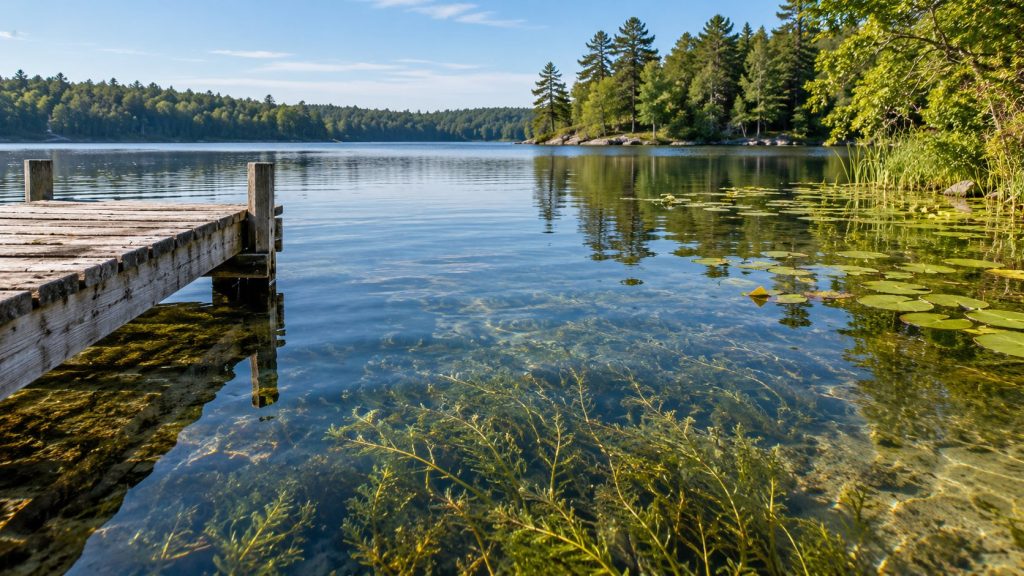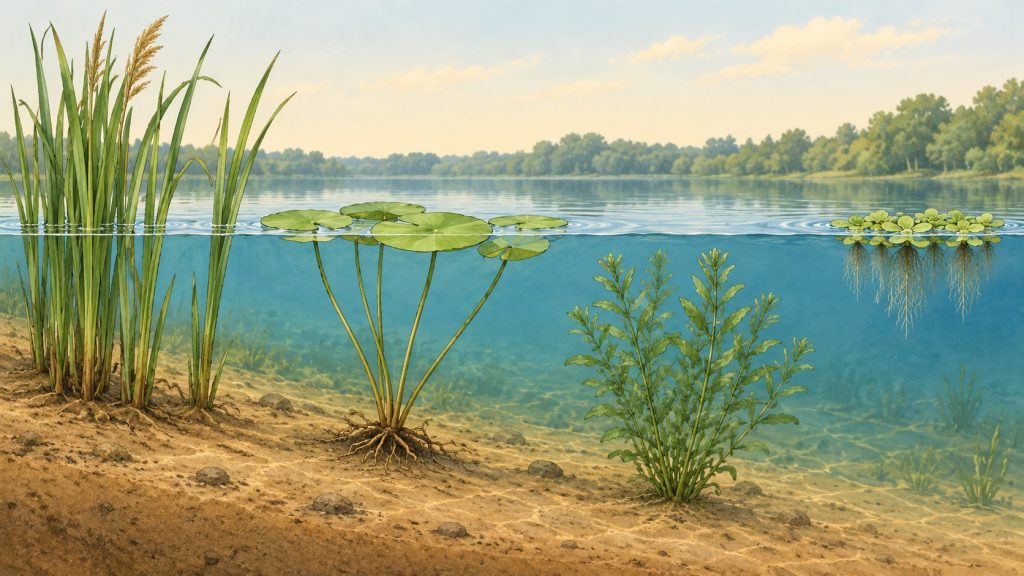
Water lilies are only one group of floating-leaf lake plants. Check leaf notches, stalk attachment, flowers and bottom connections before naming the plants.
Floating leaves make a plant bed easy to notice, yet they hide much of the plant below. A familiar round pad may belong to a water lily, while a smaller oval leaf could be watershield. A yellow flower might be a native pond lily or a different plant that needs closer review.
Rather than calling every pad a lily, follow a short comparison: how the leaf is shaped, where its stalk attaches, what the flower looks like, and whether the plant is connected to the bottom. These clues help sort several types of lake weed without assuming that a floating leaf means a free-floating plant.
Separate floating leaves from free-floating plants
A rooted floating-leaf plant has a connection to the lake bottom even though its leaves rest at the surface. A free-floating plant moves without that rooted connection. Loose leaves from either group can also drift into a corner, so a detached pad does not reveal its original growing location.
Look for a visible stalk descending from the leaf when conditions allow. Do not pull on it to prove that it is attached. You may break the stalk before learning anything useful. A safe view of several leaves in place can show more than one damaged piece brought to shore.
Our growth-form field guide explains this first sorting step. It is especially useful when tiny floating plants are mixed among large pads.
Water lilies: start with the notch
The University of Missouri waterlily guide describes round floating leaves with a deep cut, or cleft, leading toward the center where the stalk attaches. It also describes large, showy flowers and thick underground stems called rhizomes. The notch is a useful feature to include in a photograph.
Look at several intact pads. Insect damage, tears, and overlapping leaves can hide the outline. A leaf folded over another may appear to lack a notch, while a torn leaf can create a false one. Include the entire leaf rather than cropping the photo so closely that its shape is lost.
Flowers add information, but flower color alone is not enough. Garden varieties can have different colors from the familiar native white flowers. A cultivated plant in a private ornamental pond also presents a different context from an unknown plant in a natural lake.
Use the combination of pad shape, stalk connection, flower structure, and location. If the flowers are closed or absent, record that limit and compare the leaves carefully rather than inventing the missing feature.
Spatterdock: a yellow cup rather than an open flower
The Minnesota DNR spatterdock profile describes a rooted plant with heart-shaped leaves and a rounded yellow flower that rises above the water. The flower parts curve inward, giving it a cup-like or ball-like appearance. Leaves may float or rise above the surface.
That flower shape is more useful than simply writing “yellow lily.” Photograph it from the side and, if safely visible, from above. A distant yellow dot does not show whether the flower is rounded, open, or fringed.
Keep the flower connected to its leaf group in at least one image. In a mixed bed, the nearest large leaf may not belong to the flower you are photographing. A wider view helps an expert understand the arrangement.
Also note whether the leaves are resting on the water or standing above it. Do not use that one feature as a final rule, because leaf position can vary. The point is to preserve the full set of clues.
Watershield: an oval leaf without the lily notch
The Minnesota DNR watershield guide describes oval leaves with no slit, a stalk attached near the leaf’s center, and a clear jelly-like coating on the stem and leaf underside. Its flowers are much smaller than those of a typical showy water lily.
The missing notch and central attachment are useful together. An oval pad seen from above is a starting clue, but the attachment may be hidden below. Ask a specialist what additional view is needed if the visible leaf alone leaves doubt.
Do not scrape off a coating to improve a photo or assume it is a disease. It may be part of the plant’s normal structure. Describe what is present and keep the image as close to the original condition as possible.
Watershield can form an attractive bed that still leaves room for access. Before planning removal, distinguish a route problem from a dislike of seeing plants. The DNR guide highlights its value as cover for fish and food for waterfowl.
Lotus: look for a complete circular leaf
The Minnesota DNR yellow lotus profile describes a completely circular leaf with the stalk attached in the center. Leaves can float or stand above the water like broad umbrellas. Its pale yellow flower has many petals, and its seeds develop in a distinctive flat-topped structure.
A complete circle differs from a lily pad with a deep notch. Still, inspect more than one leaf before relying on that difference. A torn lotus leaf is not a different species, and overlapping lily pads can hide their notches.
Location and legal status matter here. The DNR identifies yellow lotus as a protected wildflower in Minnesota and says removal is not allowed. If you suspect it, confirm the identification with the agency before any work. Do not assume that a familiar-looking pad can be cut because it is beside your dock.
Avoid collecting attractive flowers or seed heads as a shortcut to identification. Photographs and location notes can start the review without removing part of the plant.
Yellow floating heart deserves a careful comparison
The Michigan invasive-species guide to yellow floating heart highlights five yellow flower petals with fringed edges and leaves with scalloped margins. It contrasts those features with native yellow pond lilies and white water lilies. The page also provides a reporting route for suspected finds in Michigan.
This is why “small yellow water lily” is not a sufficient identification. Look at the flower edge, the number and arrangement of petals, and the leaf margin. Keep those details together instead of selecting whichever feature resembles the first picture in a search.
A damaged or closed flower may not show the fringe well. Mark the name as uncertain and request review. Do not try to remove a suspected patch first. Ask the responsible invasive-species program about reporting and next steps in your state.
Do not move an unknown floating-leaf plant into a water garden or another lake. A decorative appearance says nothing about whether a plant belongs in the destination.
Use the leaf and flower clues together
| Plant group to compare | Leaf clue | Flower or other clue |
|---|---|---|
| Water lily | Round pad with a deep notch | Large showy flower; compare local species |
| Spatterdock or yellow pond lily | Heart-shaped leaf | Rounded yellow cup-like flower |
| Watershield | Oval pad without a slit; center attachment | Small flower; jelly-like coating beneath |
| Yellow lotus | Complete circular leaf; center attachment | Many-petaled pale yellow flower and flat-topped seed structure |
| Yellow floating heart | Rounded or heart-shaped leaf with scalloped edge | Five yellow petals with fringed edges |
The table narrows a comparison; it is not a complete key to every floating-leaf species. Size, local range, growth stage, and other structures may be needed for a final identification. Similar-looking plants outside this list are another reason to use local expertise.
A pad bed is more than surface cover
The Minnesota DNR description of floating-leaf communities explains that these beds can soften wave energy and provide fish and wildlife habitat. A broad view of the bed therefore matters when deciding whether one access issue needs attention or whether the plants can remain.
On your sketch, mark the area that actually interferes with a ladder, boat, or launch route. Keep that separate from the whole visible bed. A photograph taken straight down can make pads seem like a solid barrier even when a usable route exists beside them.
If access is a problem, discuss the identified plant and proposed route with the responsible agency. Rules for floating-leaf plants can differ from rules for submerged stems. A tool that reaches the pads does not establish permission to remove them.
The dock access guide helps organize that discussion around a limited, useful route.
Record the connection before judging regrowth
A leaf is only the visible part of many rooted floating-leaf plants. Cutting a stalk or removing a pad does not show what remains below. If new leaves appear, the work record should distinguish new leaves from plants drifting in and from growth outside the worked area.
Take photos from the same position and keep dates with them. Note whether you are comparing the whole bed or one route. A different camera angle can make a small gap appear much wider, while a lower water level can change the view of the stalks.
Use the lake plant regrowth guide when setting expectations. It explains why a clear surface after one session is not proof that the entire plant was removed.
Choose action only after the plant is confirmed
For a confirmed native bed that does not block needed access, observation may be enough. For a protected plant, follow the agency’s direction. For a suspected invasive look-alike, report it and wait for a site-specific plan before disturbing the patch.
When a separate approved shoreline task fits manual work, review the T-Weeder Tool and order one for your permitted shoreline project. Match its design to the confirmed task. This is not a recommendation to pull protected lotus, remove an entire pad bed, or assume every floating-leaf plant releases with its roots.
Keep the final identification with a few clear images. Our plant identification photo guide can help organize the record for a specialist or another owner.
Explore more Aquatic Plant Identification guides as you compare other shoreline growth.
Featured image: AI-generated illustration of a floating-leaf plant community. It is scenic concept art, not a botanical identification photograph.