Clear lake water can support more underwater plants. Learn why light matters, what clearer water can reveal, and which lake checks help guide your next step.
Understanding this link can change your first response to a green patch below the dock. A lake may look clearer than last summer while plants seem to spread farther from shore. Those changes can occur together. They do not, by themselves, tell you whether the lake is getting better or worse.
Start with two separate questions. Has plant growth changed, or can you simply see more of it? Then ask what the change means for the place you use. A narrow access issue needs a different plan from a new plant spreading across several bays.
Clear water lets light reach farther
Underwater plants need light. When light reaches more of the lake bottom, it may open more space for plants to grow. Depth, bottom type, waves, and the plants present still affect the result. Better visibility does not mean every bare spot will become a thick plant bed.
The Minnesota DNR explains where aquatic plants grow and how cloudy or stained water can limit light. It also describes why a shallow, gently sloping bay can have a wider plant zone than a steep shore. There is no single depth limit that fits every lake.
Keep this in mind when you compare your dock with a neighbor’s dock. The two sites may have different depths within a few steps of shore. A photo of clear, plant-free water elsewhere may show a steep drop rather than a successful weed-control program. Ask about the site before copying the approach.
Seeing more is not the same as growing more
Think of an underwater patch as a garden behind a window. Cleaning the window makes the garden easier to see. It does not prove that the garden grew overnight. Clearer water can create a similar surprise at the lake.
Check an old photo for more than the amount of green. Was the lake surface rough? Did sunlight reflect into the camera? Could you see the bottom at all? A dark blur under cloudy water is not a reliable record of how many plants were there.
Write down what you can confirm today. You might say, ‘Plants visible beyond the last dock post; outer edge not measured last year.’ That record is more useful than ‘Plants doubled.’ It preserves the change you noticed without turning an unknown into a fact.
Healthy lakes can contain submerged plants
A patch of plants does not automatically mean the water is polluted. The Minnesota DNR’s submerged plant overview describes these communities as a normal part of healthy lakes with suitable depth and clarity. Plants provide habitat and food-web support for fish and wildlife.
That does not make every patch harmless to every use. Plants can tangle near a swim ladder or block a boat route. A new invasive plant may also call for action. The point is to name the problem before trying to remove all the green.
For example, a few stems near a ladder may require a small access plan. A dense patch that appears far beyond the normal bed calls for identification and review. Those two situations may look similar in a close photo, but their next steps can differ.
Name what you are seeing
People use ‘lake weeds’ for several kinds of growth. Some plants have leaves and stems beneath the water. Others have leaves that float. Algae can look like strings, mats, or plantlike clusters. A lake weed plant search can bring up all of them.
Use our lake weed growth-form guide to organize the first clues. Record whether the growth is attached, floating, or washed ashore. Take a wide view and a close view from a safe position. Avoid claiming a species name from a distant green shape.
When the identity is uncertain, send photos to your local aquatic plant contact. Include the lake name, date, location, and what changed. Ask whether the plant is already known there. An answer based on the actual plant is more useful than a product chosen from a general green-water image.
Clearer water can have different causes
It is tempting to give one change all the credit. A dry month, a recent lake project, or a change in the food web may seem like the answer. A photo alone cannot sort out those causes. Ask whether the lake has records from before and after the change.
Invasive zebra mussels are one example of why clarity needs context. The Massachusetts zebra mussel guidance explains that their filtering can increase clarity and allow plants to grow deeper. It also describes damage to native species, food webs, and water-use equipment. Clearer water in that case is not a reason to welcome the invader.
Do not use clear water to diagnose a mussel problem. Many other conditions can affect what you see. Check local monitoring records and report suspected new invasive species through the agency that serves your lake. Never move organisms into a lake in an attempt to improve clarity.
Measure clarity with a consistent method
A notebook entry that says ‘very clear’ is a useful starting point. A repeatable measurement can add more value. The EPA’s water-clarity overview describes several methods, including a Secchi disk. This is a disk lowered into the water to measure how far it remains visible.
If a local lake group runs a monitoring program, use its training and method. Ask where to measure, when to measure, and how to record limits. Do not mix a casual shoreline view with formal readings as if they were the same measurement.
Write down when you could see the bottom before the disk disappeared. That observation does not tell you how far you could see in deeper water. Let the program explain how to record it. Good records state the limits of the method as well as the number.
Look beyond one water-quality number
Clarity answers a visibility question. It cannot answer every question about lake health. The Washington Department of Ecology’s lake program includes plant information and several kinds of water data. Its monitoring history includes oxygen, temperature, clarity, and contaminants.
Ask your lake association what information exists for your own lake. A current plant survey and a long series of clarity readings may reveal different parts of the story. Check the date, location, and method before comparing reports.
A reading from the deepest part of the lake may not explain a sheltered shoreline pocket. A report from ten years ago may still be useful background, but it does not describe today’s dock area. Put each record beside the question it can reasonably help answer.
Clear appearance does not prove safe swimming
Do not treat a view of the bottom as a water-safety test. The CDC’s harmful bloom guidance explains that some blooms grow below the surface and can be hard to see. It also notes that agencies cannot monitor every waterbody.
Check local swim advisories and posted notices. Stay out of water with suspicious scum, discoloration, or a bad smell, and keep children and pets away. Do not handle stranded algae to test whether it feels like a plant.
Keep this check separate from your plant-removal plan. A clear route through vegetation does not cancel a health advisory. Likewise, the lack of a notice does not prove that a site has been tested. Use current local advice when deciding whether to enter the water.
Make a small map of the change
Choose fixed features that you can find again, such as a dock corner or shoreline tree. Sketch the plant edge in relation to those features. Note places you could not see. Mark the route where growth affects your actual use.
Our simple lake weed mapping guide explains how to make that record without special software. Keep the original map when you add a new one. Replacing last month’s sketch removes the comparison you will want later.
Use the map during a call with an expert or contractor. Point to the narrow route you need and the area you want reviewed. This keeps the conversation tied to a place. It also helps prevent a broad estimate from being mistaken for a measured change in plant cover.
Plan access without chasing bare water
Set a clear goal such as reaching a swim ladder or moving a small boat to open water. Then check which methods and permissions apply to that location. Local rules can depend on the plant, method, area, and lake. Do not assume that work allowed at another property applies to yours.
For a dock problem, review our guide to planning a usable dock route. Match any proposed work to the route you need. Include debris collection, shore handling, and follow-up checks in the plan.
If manual work fits an allowed small-area job, review the T-Weeder Tool and order one for your planned access work. Match its features to your reach, footing, and plants. A tool choice should follow the site check, with a clear work boundary.
Use the next visit to answer one question
Choose one useful follow-up. You might confirm the plant name, repeat a trained clarity reading, or photograph the same patch from the same spot. A focused visit is easier to repeat than a long list of vague checks.
After several visits, separate observations from explanations. ‘Outer plant edge moved beyond the post’ is an observation. ‘Clearer water caused the change’ is an explanation that may need more evidence. Keep both in your notes, but label them clearly.
Find more practical routines in Seasonal Care and Water Quality. Clear water and underwater plants can share the same lake. Careful records help you decide which change matters and what kind of help will move the decision forward.
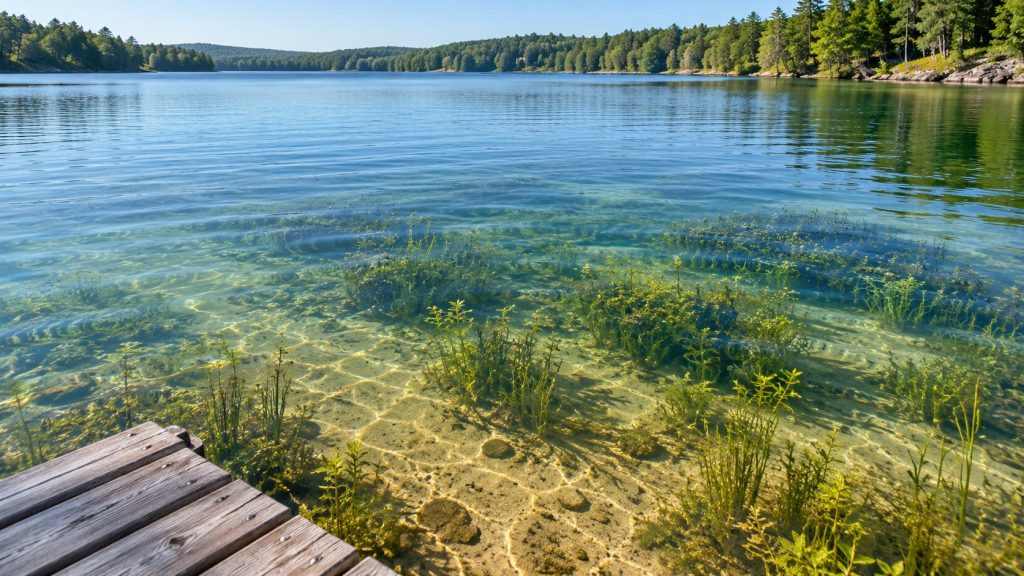
Image note: The featured image is an AI-generated illustration. It is not a plant-identification photo, a water-safety test, or evidence of a treatment result.