Plan Lake Minnetonka weed removal with clear steps for plant permits, local agencies, dock access, disposal, and records before you schedule shoreline work.
Coordinating a project starts with knowing what the job includes. Pulling plants beside a dock is one task. Moving that dock, changing the lakebed, or clearing shore trees adds other tasks. The same contractor may offer all of them, but one approval does not necessarily cover the whole list.
This guide uses current agency information checked on October 27, 2026. It focuses on how a Lake Minnetonka property owner can prepare a clear plan. Confirm requirements with the offices responsible for your site before booking work or changing its scope.
Give the problem a precise location
Start with the bay, street address, and city where the property sits. Add a map pin and two or three current photos. Lake Minnetonka is a large shared lake. A description such as ‘the weeds by our dock’ gives a reviewer too little to work with.
Show the exact route that needs access. Explain whether you want to reach a boat lift, use a ladder, or move a small boat to open water. Include water depth where you know it. Label estimates so they are not mistaken for surveyed measurements.
The lake weed mapping guide provides a simple way to mark patches. Keep the drawing small enough to read on a phone. A few clear landmarks are often more useful than a crowded image covered in notes.
Send each question to the right office
The LMCD resource directory directs private aquatic vegetation questions to the Minnesota DNR. It lists LMCD for public navigation-area harvesting questions and identifies other contacts for docks, shoreland work, and related issues. Use the directory to find the correct starting point. It is not a promise that a public program will service your private frontage.
The Minnehaha Creek Watershed District’s permitting FAQ is explicit: MCWD does not issue aquatic vegetation removal permits. It points those requests to the DNR. It also directs Lake Minnetonka dock permit questions to LMCD.
Write separate lines for plant removal, dock changes, shore access, and any lakebed work. Ask the responsible office about each line. Keep copies of referrals. That makes it easier to show that a question was passed to the right reviewer instead of assuming that silence meant approval.
Check the limited state permit exceptions
The DNR allows certain limited access work without an aquatic plant management permit. Under Minnesota Rule 6280.0250, submerged-plant control for swimming or boat docking must stay within 2,500 square feet, plus a needed channel to open water no wider than 15 feet. The shore width cannot exceed 50 feet or half the owner’s frontage, whichever is less. The channel counts within that shore-width limit.
Floating-leaf plants have a separate channel exception. It requires the most direct route, a width no greater than 15 feet, cutting or pulling, and the same location from year to year. These exceptions remain subject to other restrictions. They are not permission to clear every plant type in a small space.
An issued APM permit also matters. The rule does not allow the submerged or floating-leaf exceptions to be added at the location and during the period covered by that permit. Review the actual permit before arranging extra work. Our Minnesota removal guide gives more background for that conversation.
Identify what grows in the proposed area
Lake Minnetonka has both native and invasive aquatic plants. LMCD’s species page lists examples of each and provides a way to report suspicious plants or animals. Its invasive list includes Eurasian watermilfoil, curly-leaf pondweed, and flowering rush. A thick patch beside your dock still needs its own identification.
Take a broad photo of the patch and close views of leaves and stems. Record the date, depth, and whether the plants reach the surface. A loose fragment on a boat propeller may have drifted from elsewhere. Mark it as a loose find rather than claiming a rooted bed at that spot.
If identification remains uncertain, ask for help before treatment. Avoid clearing a mixed bed under the name of a single invasive plant. Tell the reviewer which plants you expect to remove and which will remain. That detail can affect both the method and the permit path.
Recognize tasks that need more review
The DNR’s aquatic plant regulations page identifies permit needs for emergent plants, herbicides, automated devices, and work beyond applicable exceptions. It also lists prohibited practices, including excavating the bottom for plant control and using hydraulic jets. Disposal away from your property requires the plant transport authorization described there.
Do not replace a careful method description with a product name. Explain whether the device cuts stems, pulls plants, stirs sediment, or stays in the water unattended. Those effects help an agency assess the job. A sales term such as ‘natural cleaning’ does not answer the legal question.
Write down what the method will leave behind. Roots, loose fragments, and sediment clouds have different meanings. Ask how the operator will collect plants and prevent the task from spreading outside the planned area. If the answer is vague, resolve it before the crew arrives.
Keep dredging outside a plant-only work order
A shallow route may have two separate problems: tall plants and too little water depth. Removing stems does not deepen the lakebed. A proposal to suck out muck, scrape soil, or cut a deeper passage needs a different review from ordinary plant handling.
MCWD’s dredging rule requires a district permit for covered dredging and points to other required agency approvals. Lake Minnetonka navigational dredging is subject to a joint policy involving MCWD, DNR, and LMCD. The rule also requires consideration of alternatives. A plant permit should not be treated as approval to move sediment.
Ask a provider to separate those tasks in writing. If the visit reveals a depth problem, stop the plant job from quietly becoming a lakebed project. Record the observation and return to the agencies. A revised plan is easier to review than an unexplained change made underwater.
Coordinate with neighbours and shared access
A dock association or shared frontage can make responsibility less clear. Identify who owns the land, who manages the dock, and who may request work. Gather the relevant agreement before asking a contractor to remove plants. One resident’s request may not speak for every user.
Discuss boat traffic and work dates with nearby owners. A narrow access lane can cross several people’s normal route to open water. Explain the planned limits and collection method. A brief conversation can reveal water intakes, cables, or planned dock work that your sketch missed.
Keep neighbour consent separate from agency approval. Both may matter, but they answer different questions. Record concerns without promising a result you cannot control. If the work changes, update the affected people as well as the appropriate reviewer.
Make the quote match the reviewed plan
Give each provider the same map, species notes, and task description. Request a price for that scope, not a broad promise to ‘clean up the lake.’ Ask whether the quote covers collection, loading, transport, disposal, and a later check. List any owner duties clearly.
Ask who secures each permit or authorization and who keeps it on site. Confirm that the provider has the credentials required for the proposed service. A document for one method or property may not cover another. Read its dates and conditions rather than checking only the company name.
Use the lake weed cost guide to compare the full job. Avoid comparing a disposal-included quote with one that leaves wet material on your lawn. A low starting price can hide a large amount of work still assigned to you.
Set up a manageable workday
Before work begins, review the boundary with everyone involved. Show the access route, collection area, plants to retain, and stop points. Keep the current plan available in a dry folder or on a phone. Agree on who can approve a pause and who contacts the agencies if questions arise.
For a small task that is allowed and suits a manual method, view and order the T-Weeder Tool. Match its features to your reach, plant type, and safe access. The tool’s availability does not establish an exemption or make unsafe water suitable for work.
Plan collection and cleanup as part of the job. Arrange an accepted disposal route and any required transport paperwork before loading. Inspect tools and other equipment before moving them to another waterbody. Do not let the last step become an improvised trip with loose plants on the trailer.
Keep records that help next season
Photograph the work area from the same points afterward. Note the date, method, actual area, and amount of time spent. Describe whether the boat or ladder can now be used as intended. A useful record measures access, not just how bare the water looks.
Check again after ordinary use and changing weather. Note whether plants regrow inside the lane or drift in from elsewhere. Those are different problems. A return visit should follow the same approved limits unless a revised plan has been reviewed.
Keep the photos, quote, invoices, permits, and emails together. Add a short note about what you would change next time. If several owners share the project, give them a common copy so next year’s organizer does not have to rebuild the history from memory.
For example, a record might say that the ladder was usable after a small removal task but loose fragments returned after a windy day. That points toward collection and observation rather than an automatic wider clearing. Record what you saw without claiming you proved the cause.
Browse the Permits and Invasive Plants guides for future planning. Lake Minnetonka work goes more smoothly when every task has a clear owner, a clear limit, and the right review before it starts.
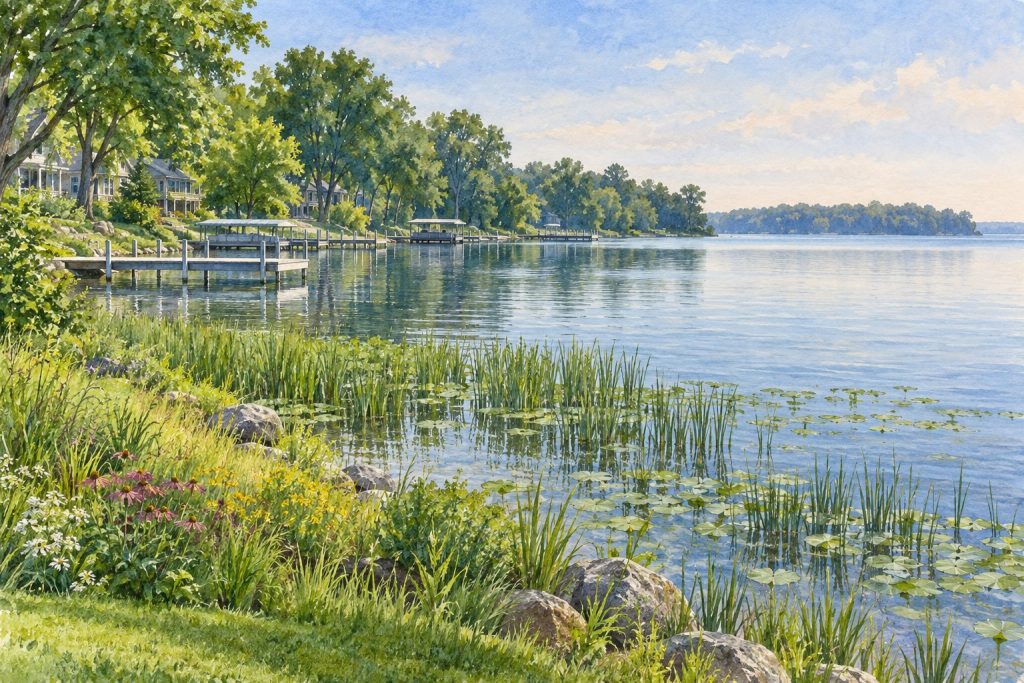
Image note: The featured bay scene is AI-generated. It illustrates shared lake access and does not show an actual Lake Minnetonka property, legal boundary, or tested removal result.