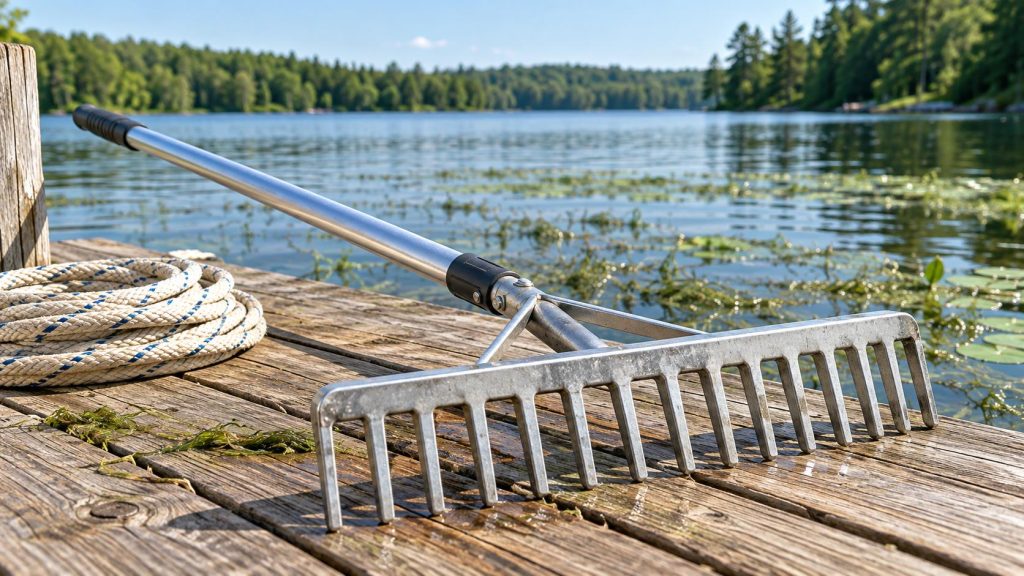
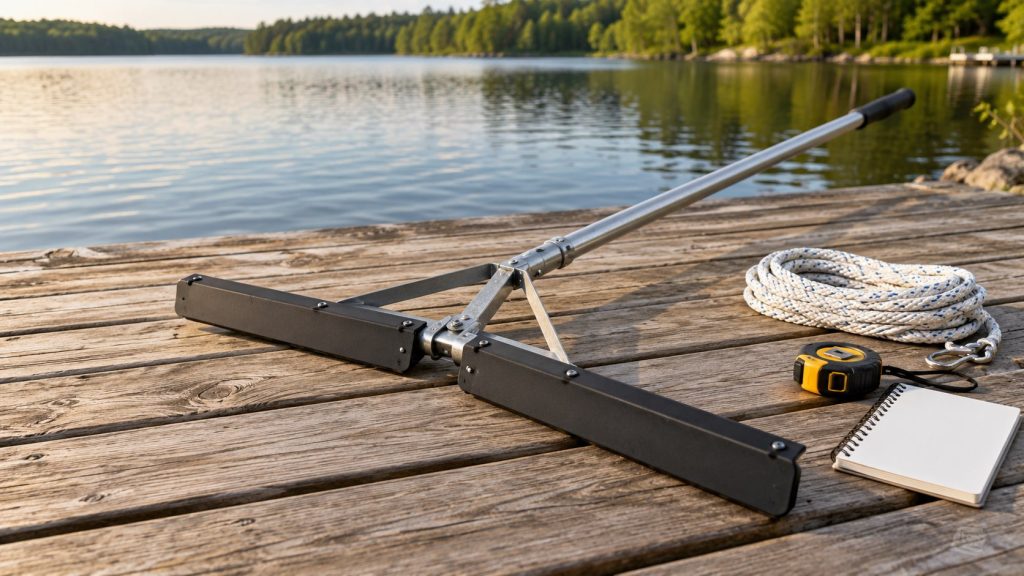
Lake weed rake reviews help most when the reviewer’s plants, shoreline, and task match yours. Compare key details, limits, and follow-up before star totals.
Reading twenty reviews can leave you less certain than reading two. One owner calls a rake light and easy, another calls it tiring, and both may be telling the truth about different jobs. The way to make reviews useful is to connect each comment to a task, a setting, and an amount of use.
This guide does not rank brands or claim that we tested competing rakes. It gives you a practical way to turn owner reports into questions you can check against a manual, product details, and your own shoreline plan.
Write your job description before reading ratings
Describe the work in one sentence. For example: “I need to gather loose cut plants beside a dock from stable ground.” That is a different task from reaching submerged stems with a long handle or retrieving a rake on a rope. A positive review for the wrong task can be less useful than a mixed review for the right one.
Add a few facts: the plant form, the area you can work, the distance from your standing point, the collection spot, and the person who will use the tool. Keep unknowns visible. If you do not know the plant, do not pretend that “thick weeds” is a precise match.
Use the lake weed rake buying guide to define the features that matter for that job. Then look for reviews that discuss those features in use.
Confirm the exact model and configuration
A retailer may group several sizes or versions on one page. Check which rake each reviewer bought. Look for the head width, handle arrangement, rope option, and any float or attachment. A complaint about one connector design may not describe the version currently for sale.
The review date matters too. An older report can be valuable for long-term use, but the product may have changed. Ask the manufacturer whether a part mentioned in a review is still used. Do not assume that an updated color or product photo proves a structural change.
The Jenlis Weed Raker manual, for example, lists separate teeth, support brackets, handle connectors, and rope parts. A parts diagram can turn a vague review about “the joint” into a specific question. Use the diagram for your actual model; the example does not establish comparative quality.
Give detailed work descriptions more weight
A useful review explains what the owner did. It might mention gathering loose stems, working from a low dock, taking small loads, or needing help with a long return. Those details help you decide whether the experience transfers to your site.
A statement such as “best rake ever” tells you the owner was pleased, but it does not tell you why. A statement such as “the head fits beside my ladder, but unloading takes longer than pulling” provides a concrete tradeoff. You can check the dimensions and plan the unloading step.
Do not require perfect writing or technical terms. A plain description with a clear photograph may be more useful than a polished paragraph full of claims. Look for observations that another owner could understand and compare.
| Review detail | Useful question for your site |
|---|---|
| Plant type and condition | Am I gathering the same kind of material? |
| Standing point and reach | Will my stance and handle angle be similar? |
| Length and number of sessions | Is this an unboxing view or a report after repeated work? |
| Load size and unloading | Can I manage the complete work cycle? |
| Named part that failed or wore | Does my model use that part, and can it be replaced? |
| Follow-up after support contact | Was the issue resolved, and how? |
Read positive and negative reviews for different clues
Positive reviews can reveal the task a tool fits especially well. Negative reviews can reveal limits, missing instructions, difficult assembly, or a mismatch. Neither group should be accepted as a complete product test.
Separate a tool failure from a delivery problem. A damaged shipping box matters when choosing a seller, but it does not by itself tell you whether the rake head works well. Likewise, a friendly customer-service response does not erase a repeated mechanical problem.
Look for patterns across independent reports. Several owners naming the same part and describing similar use deserve a closer question to the maker. Do not count the same review copied across three sites as three independent experiences. Keep links in your notes so you can spot duplicates.
Avoid turning a handful of complaints into a calculated failure rate. You usually do not know how many units were sold, how many owners never reviewed, or how the tools were used. “Several reports worth checking” is more honest than an unsupported percentage.
Treat star averages as a starting point
The Federal Trade Commission’s review guidance recommends considering multiple sources, review dates, reviewer history, and possible incentives. It also warns that readers cannot reliably spot every fake review just by looking. Fake reviews may be positive or negative. A rating is a prompt to investigate, not a substitute for that work.
Look at the number of reviews behind an average and how they are spread over time. A high score based on a few short comments leaves more unanswered questions than a large collection of specific reports. Still, quantity alone does not prove quality or relevance.
An incentive label tells you something about the source of a review, but it does not automatically make every observation false. Read the content and keep the context in mind. Be equally cautious about assuming that an angry review must be more independent or accurate.
You do not need to accuse a reviewer of dishonesty to decide that their report is too vague to help. Put it in the “little useful detail” group and move on.
Translate comfort claims into a real handling question
“Lightweight” often describes the empty tool. Your work includes water resistance, gathered plants, the length of the handle, and the distance of the load from your body. Ask whether the reviewer discussed those conditions or only the first lift from the box.
The CCOHS guide to hand-tool design explains that weight, shape, fit to the user, work layout, and task scheduling all affect tool use. That is why a comfort claim from one person should not become a guarantee for everyone.
Look for practical details: could the owner keep a steady stance, take small loads, and unload without an awkward lift? Did they shorten a session or change the setup? Those details are more useful than a claim that the tool takes “no effort.”
The long-handle rake guide helps you evaluate reach claims, while the throw-rake guide covers the different demands of rope retrieval.
Watch for results that the evidence cannot show
A photo of a pile of plants shows that plants were collected. It does not prove that roots were removed, that the whole area was cleared, or that growth stayed away. A before-and-after image without dates can hide the time between views or a seasonal change.
Read the claim at the scale of the evidence. An owner’s report after one session can support a description of that session. A season-long update can add information about repeat work and wear. Neither proves that every species or shoreline will respond the same way.
Be especially careful with claims about muck, permanent removal, or a weed-free lake. Ask what was measured and what other work occurred. A rake can gather plants while leaving a separate sediment problem unresolved. Our plants versus muck guide explains that distinction.
Use a simple comparison sheet
Make one row for each candidate rake and three columns: confirmed facts, useful owner observations, and unanswered questions. Put dimensions and parts from the manufacturer in the first column. Put detailed experiences from reviews in the second. Keep guesses out of both.
For an imaginary example, Rake A has a confirmed long handle and several reviews about reaching from low banks. Rake B has a shorter handle and detailed reports about collecting loose cuttings close to a dock. If your job is close collection, B may deserve more attention even if A has a slightly higher average rating.
Do not turn that example into a scoring formula that hides important limits. A missing safe standing area cannot be balanced away by points for low price. Decide which requirements must be met first, then compare convenience and cost among the remaining options.
Ask the seller questions that reviews cannot settle
- Does the current version use the same parts mentioned in older reviews?
- Which exact tasks and plant forms is the rake designed for?
- What replacement parts are available, and how are they ordered?
- What assembly or maintenance steps commonly cause confusion?
- What are the return terms after assembly or water use?
- What does the warranty cover, and what documentation is needed?
The FTC online-shopping guide recommends checking the full cost and return terms and keeping purchase records. Read those terms directly. An old review saying “easy return” does not establish today’s policy for your seller or for a tool that has been used in water.
Save the answers and the listing at the time of purchase. This gives you a better reference than relying on memory if an accessory is missing or the delivered model differs.
Make a decision with clear reasons
A useful final note might read: “This rake fits our close-to-shore collection task, parts are available, and reviews from similar sites describe manageable loads. We still need to confirm storage space.” That is a stronger buying basis than “it has the most stars.”
When the design fits your approved shoreline work, review the T-Weeder Tool and order one for your permitted shoreline project. Apply the same questions to that purchase: task fit, complete handling, care, support, and the actual sale terms.
Explore more comparisons in the Lake Weed Tools guides.
Featured image: AI-generated illustration of comparing tool information. The blank review cards do not represent real customers, ratings, or product tests.