Duckweed and algae can both cover lake water green. Look for separate small plants, threads, or paint-like water before choosing what to do about the cover.
Surface color is the first thing most owners notice, but it is often the least useful clue. A sheltered cove can hold tiny floating plants, stringy algae, pollen, and loose pieces from other plants at the same time. Before buying a lake water weed product, decide whether you are seeing separate plants, a connected mass, or color within the water.
That first sorting step helps you ask a better question. It does not certify that the water is safe for swimming, pets, or drinking. Identification and water-use advice are separate decisions.
Start with a view from dry ground
Walk to a safe viewing point and look at the whole area. Note whether the cover is only against one bank, spread through a sheltered bay, or visible across open water. Take a wide photo that includes a recognizable shoreline feature. Then make closer photos using zoom without leaning over an unstable edge.
The CDC guide to recognizing harmful algal blooms says discolored, scummy, or bad-smelling water can signal a problem. Stay out and keep children and pets away when those signs are present. Appearance cannot tell you whether a bloom contains toxins, and the absence of a posted advisory does not prove that a waterbody has been checked.
Do not use your hands, a swimming trip, or a pet’s reaction as an identification test. If you suspect a bloom, photograph it from shore and contact the local health or water agency. Ask that agency whether a sample is needed and how it should be collected. The comparison below helps describe observations; it is not a reason to handle suspicious material.
Duckweed looks like many separate little units
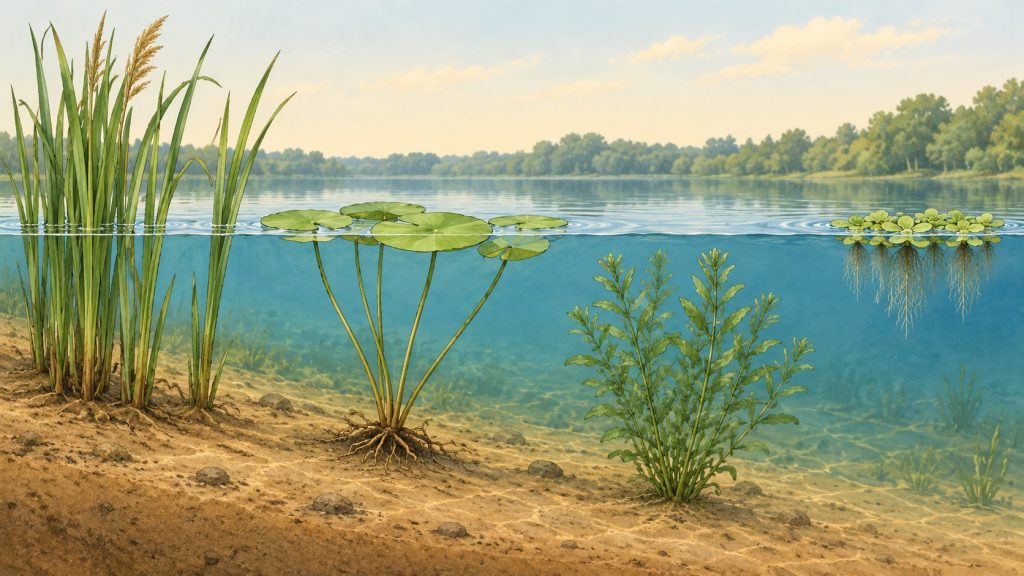
The Minnesota DNR duckweed and watermeal guide describes tiny, free-floating plants that can form a green surface blanket. Duckweed typically has a small leaf-like body or cluster with roots hanging below. Unlike a stringy algae mat, the individual plants are not connected into one continuous network.
The useful question is whether you can see repeated, separate shapes. A close photo may show small oval or rounded pieces lying beside each other. Each piece is a plant body, often called a frond. You do not need to memorize the term; you need a picture that shows the individual units.
A thick cover can hide that detail. At the edge of a patch, scattered plants may be easier to see than the densely packed center. Photograph both areas from a safe position. Do not assume that the open space between patches has the same water conditions as the covered area.
Duckweed can be mixed with other growth. Identifying several floating fronds does not explain every green streak in the photo. Keep a separate note for any material that looks different.
Watermeal is a small but useful look-alike
The Penn State Extension duckweed and watermeal guide, updated in 2025, explains that watermeal is smaller than duckweed and lacks hanging roots. Its tiny bodies can resemble grains on the surface. Both are flowering plants, even though their flowers are too small to be useful in a casual shoreline check.
A grainy-looking cover is therefore not automatically algae. If your camera cannot resolve the individual pieces, say so. Ask an Extension office or aquatic plant specialist what close-up or sample they need. Guessing from a distant green patch can lead to selecting a product meant for an entirely different type of growth.
Do not make visible roots an all-or-nothing test for every free-floating plant. A root may be hidden below the surface or absent from a damaged piece. The source comparison should match the plant group you are considering. Use size, body shape, and the whole growth pattern together.
Filamentous algae forms threads or connected growth
The Texas A&M AQUAPLANT identification guide separates algae into several forms, including thin, string-like growth and microscopic forms. “Algae” is a broad group, not one texture. A thread-like mat and water colored by tiny suspended organisms should not be treated as the same visual problem.
In a good close-up, filamentous algae may look like intertwined strands rather than rows of separate little floating plants. The strands can hold other debris, so look for the underlying structure instead of naming the whole clump by whatever is stuck to it.
A photo of a connected mat can help an expert narrow the possibilities, but it cannot establish whether harmful organisms or toxins are also present. Keep water-use questions with the appropriate agency. Do not translate “looks stringy” into “safe.”
For a broader comparison of plant growth and algae, see our lake algae versus plants guide. It explains why the next step depends on the kind of growth and the problem it causes.
Paint-like water needs a different response
Sometimes there are no clear fronds or threads in the view. Instead, the water appears stained, streaked, or coated like spilled paint. Record that description rather than forcing it into a duckweed label. Color alone will not identify the organism.
Check current local advisories and follow the agency’s instructions. When reporting, include the lake name, nearest public access or landmark, date, time, and where the material is concentrated. An agency may ask for additional views or arrange testing. A commercial treatment choice should wait until the problem has been identified and the relevant advice is clear.
A common mistake is to see a few recognizable duckweed plants and dismiss the rest of the surface color. The two observations can exist together. Describe both: “small separate plants at the edge, green streaks farther out.” That is a more useful report than choosing a single label for the whole bay.
Compare structure before comparing color
| What you can see | Possible direction for identification | Important limit |
|---|---|---|
| Separate rounded or oval floating bodies | Duckweed or another small floating plant | One photo may contain more than one kind of growth |
| Very small grain-like bodies | Watermeal deserves comparison | Distant specks are not enough for a species name |
| Connected threads or a tangled mat | Filamentous algae deserves comparison | Texture does not establish water safety |
| Discolored water, scum, or paint-like streaks | Possible bloom; seek agency advice | You cannot judge toxins by appearance |
| Powdery yellowish material | Pollen is another possible look-alike | Color and smell alone do not confirm it |
Use the table to choose the next question, not to announce a final diagnosis. If the material fits more than one row, document that. A mixed patch is common enough that a single-name answer may be less useful than a clear description of two or three visible forms.
Remember pollen when the timing fits
The University of Georgia guide to common pond look-alikes includes pollen alongside duckweed, watermeal, and algae. It notes that pollen can have a powdery appearance and is often more yellow. The article also explains why identifying the material should come before selecting a treatment.
This does not mean every yellow film is pollen. Add context: are nearby trees shedding pollen, and did the film appear after a windy period? Keep that observation separate from certainty about what is in the water. A seasonal clue supports a comparison; it does not replace one.
If an expert confirms pollen, the answer may be to observe and wait rather than buy a plant-control product. That can be a useful outcome. The aim is to solve the actual problem, not to make every surface change into a removal project.
Record movement without assuming new growth
Take another photo from the same point later, noting the wind direction and conditions. Surface material can collect on one bank and shift elsewhere. A patch that looks larger at your dock may reflect concentration, growth, or both. Photos from only one corner of a lake cannot separate those explanations.
Use landmarks to divide the view into a few zones: ladder area, open dock side, and sheltered bank, for example. Note which zone is covered and whether the cover looks scattered or dense. Avoid claiming an exact percentage if you cannot see the whole area.
Our floating plant return guide explains how drift changes what you see after a cleanup. This is especially useful when the same corner fills again even though the work was thorough.
Choose the next step that fits the finding
For confirmed duckweed or watermeal, ask a local specialist whether management is needed and what options fit the waterbody. Tiny floating plants are a different task from rooted stems. A wide rake may let small plants pass between its teeth, while a cutter may have no useful role at all.
For confirmed filamentous algae, discuss the extent, location, and underlying conditions before selecting a method. Do not assume that a product labeled for rooted weeds treats algae, or that an algae product treats duckweed. If a chemical treatment is proposed, the exact label and local approval govern its use.
For a suspected harmful bloom, the immediate decision is about avoiding exposure and following agency advice. Raking, stirring, or spraying the visible patch is not a substitute for that advice. Keep the identification record so the agency can compare observations over time.
When a separate, identified rooted-plant problem calls for suitable manual shoreline work, review the T-Weeder Tool and order one for your permitted shoreline project. The product should be chosen for a matching task; this article does not present it as a treatment for tiny floating plants or harmful blooms.
Send a useful identification request
- Name the waterbody and give a precise location or clear landmark.
- Include one wide view and several closer views taken safely from shore.
- Describe separate plants, grains, threads, or water discoloration without guessing beyond what you see.
- Give the date, recent wind conditions, and whether the material moved.
- Mention any posted advisory and any different-looking growth in the same area.
- Ask what further evidence is needed before taking action.
Use our identification photo guide for organizing the images. Keep the expert’s reply with the original photos so next month’s comparison has a reliable starting point.
Find more comparisons in the Aquatic Plant Identification guides.
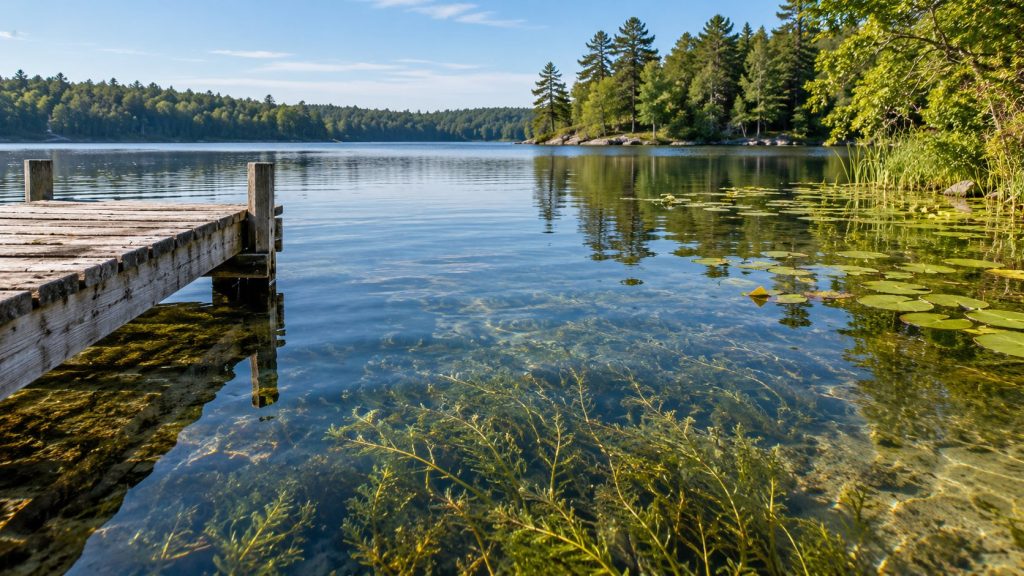
Featured image: AI-generated concept illustration of green surface patterns viewed from shore. It is not an identification photograph or evidence that water is safe.