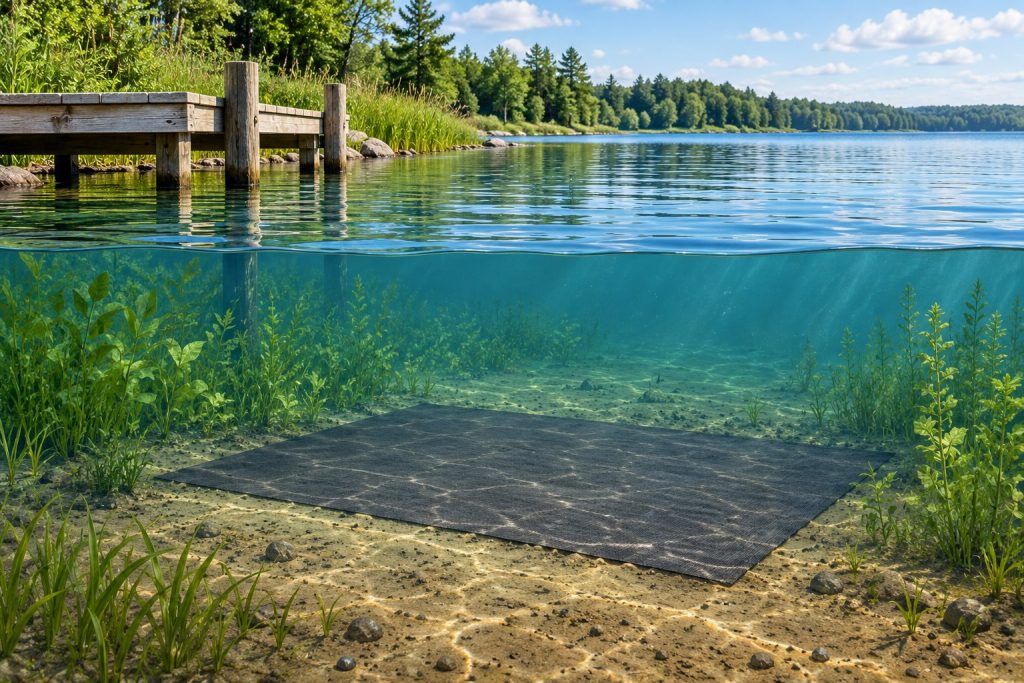
Use lake weed mat reviews to compare site conditions, materials, anchoring, upkeep, and total costs before deciding whether a bottom barrier fits your lake.
Reviews can make two similar mats seem very different. One owner praises the clear patch beside a dock. Another reports shifting edges, cleaning work, or new plants. Both may be honest. The lake, setup, care, and goal can affect the result. Read those details before you decide that the fabric caused the difference.
Treat each review as a report about a project. Look for facts that match your site and questions worth asking the seller. This guide draws on agency and Extension sources. It does not rank brands or claim that we tested competing mats. For the basic method, read how lake weed mats work.
Start with permission and site fit
First check whether mats are allowed at your site. Minnesota DNR’s rules, for example, prohibit bottom barriers used to destroy plants or prevent their growth. A good review from another state does not permit that work in Minnesota. Other places have their own rules. Resolve this question before spending time comparing ratings or features.
Describe the project to the agency in charge. Include the plant, lake, location, mat size, material, dates, and removal plan. Ask which facts determine whether the method is allowed. Keep the answer with your shopping notes. Do not add a product to your short list if its planned use conflicts with the site’s rules.
Make a brief site record too. Note the depth, bottom firmness, slope, waves, and boat use. Can you reach the area to check the mat? Add the goal, such as a small access point or an invasive patch in a larger control plan. These facts let you judge whether another owner’s review is relevant.
Look for a reviewer with a comparable lake
A mat used in a quiet pond may face different demands on a busy shore. Look for the reviewer’s plant type, bottom conditions, mat size, setup, and season of use. When these are missing, you have an opinion but little evidence about fit. A five-star rating cannot fill those gaps in the site description.
NIWA’s bottom-lining guide describes problems that can arise on uneven or unstable bottoms, in strong waves or currents, and where sediment builds up. Sediment is the material that settles to the bottom. The guide also notes that barrier materials can serve different purposes. A useful review tells you enough to compare these site factors.
Ask what success meant to the reviewer. Did they want fewer stems under the mat, easier swim entry, or no plants across a bay? These are very different goals. A product might meet one and miss another. Compare the reported result with your own goal before counting the review as evidence in its favor.
Separate delivery reviews from season-long results
A review posted on delivery day can tell you about shipping, packing, missing parts, and clear instructions. Those details matter. They do not show how the mat will perform underwater through a growing season. Record when the review was written and how far the owner had got. Treat a delivery report as a delivery report.
Look for later accounts covering setup, checks, cleaning, removal, and storage. An owner who completed a season can describe work a new buyer has not yet faced. Check the dates and exact model. Ask whether the frame or fabric has changed. An old review can be useful without proving how today’s model will perform.
Look closely at before-and-after photos. Do they show the same spot, angle, and time of year? Were plants pulled or treated first? Was the later photo taken just after cleaning? Missing context does not prove that a photo is false. It limits what you can conclude from it. Ask about those details before relying on it.
Compare the complete material system
List the fabric, frame, seams, edges, and anchor parts for each option. Thickness alone does not describe the system. Ask how each part handles the conditions at your lake. Which parts can be repaired or replaced? Is the seller quoting a complete kit? A material name is only one part of the comparison.
Ask how the mat lets trapped gas escape. Texas Parks and Wildlife’s plant guide explains that gas can lift a barrier off the bottom. It discusses partly permeable material, which lets some gas pass through. Ask how the proposed design addresses this and what checks the maker requires. Do not assume all fabrics behave alike.
Some materials are meant to break down; others are meant to be reused. Judge a material that breaks down against the planned treatment period and goal. For a reusable mat, include retrieval, cleaning, storage, and repair. Neither description alone makes one the better choice. Ask what useful life means under your planned conditions of use.
Read maintenance complaints for useful detail
A complaint about difficult upkeep is more helpful when it names the task. Was the problem lifting a wet mat, finding an edge, clearing sediment, or carrying parts to storage? Turn that detail into a question for the seller. Ask them to explain how the task would be done at your depth and access point.
Upkeep is part of this method. Cornell Extension’s barrier overview discusses secure anchors, sediment buildup, zebra mussels growing on mats, and the work of setup and care. Pay attention when a review describes these tasks. A high overall rating does not mean that the same owner found every task easy or could skip routine checks.
Separate ongoing work from damage to the product. A mat can stay intact yet need more care than you can provide. Another may be easy to handle but develop tears or other damage. Ask which issue the review describes. Then ask what the maker’s care directions require and whether the owner followed them.
Evaluate the source without guessing who is honest
The FTC’s review-reading advice suggests checking who supplies the information and comparing sources. It also warns that you cannot spot every fake review by its appearance. Build a broader picture from specific facts. One enthusiastic sentence is not enough to prove either that a review is honest or that it is fake.
Look for notes about free products, payment, or rewards for reviews. Such ties help explain the context. They do not make an account useless, but other evidence is worth seeking too. A verified-purchase badge may show that a sale occurred. It does not prove that the buyer used the mat correctly or for long.
Notice specific points that recur across separate reviews. If several owners describe a hard removal step, ask to see it demonstrated. Read the seller’s reply to a complaint as well. Does it explain what went wrong and how to fix it? A useful response states the remedy and its limits, rather than only offering reassurance.
Build a comparison sheet with missing information visible
Use the same fields for each candidate. Record the model, allowed use, coverage, included parts, setup, checks, removal, storage, warranty, and full quoted cost. Add useful reviews with dates and site details. Mark gaps as unknown. This puts unlike products on a common page and makes the next call to a seller more focused.
Do not turn unknowns into scores just to pick a winner. If no review mentions winter removal, that does not mean it can be skipped. No anchor complaints do not prove the design suits your bottom. A short list of unanswered questions is often more useful than a high average score built on missing facts.
Try three labels for each field: fits, needs an answer, or does not fit. Ask the seller to resolve the key gaps. Permission and workable setup matter more than a star count. A product should not win while either issue remains unknown. Use the same standard for each option so the comparison stays fair.
Read the warranty and quote together
Read the warranty’s coverage and care terms. Does it cover the fabric, frame, seams, or spare parts? Who pays return shipping? Is the remedy repair or replacement? Ask what the owner must do to keep coverage. A warranty lasting several years is not a promise that weeds will stay controlled for that whole period.
Request a price for the full project. Include site review, material, anchors, setup, checks, upkeep, removal, and storage where needed. Ask which costs recur. A reviewer may call a mat cheap because they supplied their own labor and equipment. Their price may leave out work that you would need to pay someone to do.
Imagine one package includes just a mat. A second includes the mat, setup, and a removal visit. The second can cost more even if the material is similar. This is a made-up example, not a price quote. Match the services before comparing totals. Ask for current written prices instead of relying on an old review.
Compare a mat with the work you could do manually
A mat is one option for a defined plant problem. For a small area, compare it with permitted hand removal when that is practical. Our lake weed removal guide includes collecting plants, disposal, and return visits. Use the same goal and area for both. Otherwise, their costs and work demands will not mean much side by side.
If a hand tool suits that work, compare reach and handling with your site, then order a T-Weeder tool for your planned manual project. The lake weed rake buying guide can help organize that choice. A manual option may fit one small project while a barrier fits a different approved project; neither conclusion follows from reviews alone.
You should be able to explain your choice in a few sentences. The method is allowed. The product fits the site. Someone can do the ongoing work. The full cost is clear. If the main reason is still a high star rating, answer the gaps before buying. Good reviews support a decision; they cannot make it for you.
Keep your notes for the first season’s review. Compare the result and work with what you expected. That record can also help you write a useful review for another owner. Browse Weed Mats, Rollers and Blowers for more comparisons. Use your own site details and care records when deciding whether to continue, change, or replace the system.
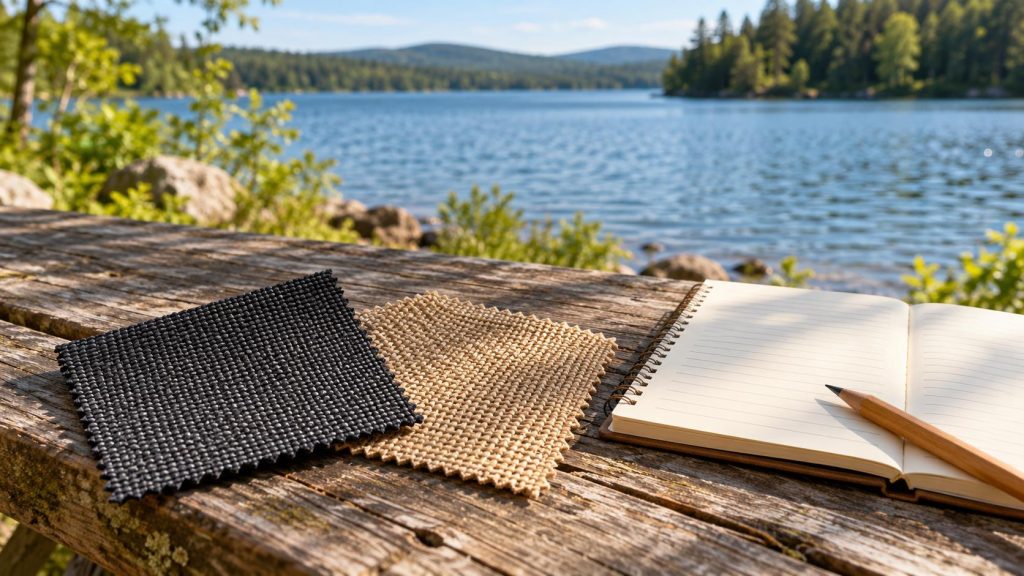
Featured image: AI-generated illustration of generic material samples and a planning notebook by a lake. It does not show specific commercial products or results from a product test.