Used lake weed tools can save money when a model, condition, and parts fit your project. Inspect the whole tool and add repair costs before agreeing to buy.
Shopping for a used lake weed removal machine can bring up everything from a simple rake to a powered harvester. Start by separating those categories. A quick inspection may help you assess a manual tool, but a motorized machine needs a qualified review of its power system, controls, guards, and working parts.
The asking price is only one part of the decision. You also need to know what is missing, whether replacement parts exist, how the equipment was used, and whether it can be moved to your lake under current rules. A bargain that cannot be repaired or legally moved may not be a bargain at all.
Identify the exact item before the visit
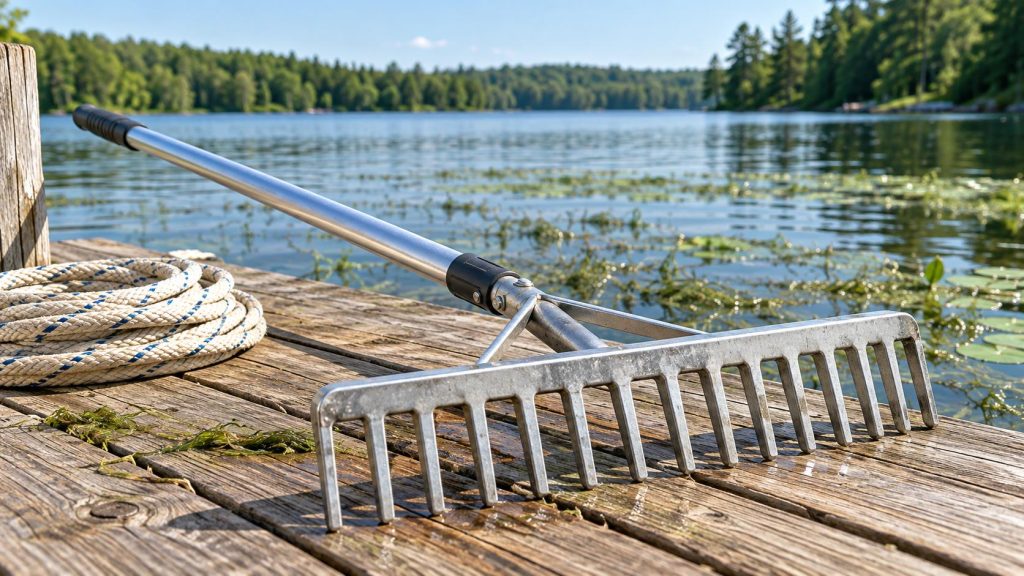
Ask for clear photos of the whole tool, model label, serial number if present, working head, handle joints, and included accessories. Request the manual or a link to it. A listing that says “lake rake” does not tell you whether the tool is designed to skim floating material, gather submerged plants, or cut stems.
Check the current manufacturer’s information for that exact model and version. Similar names can hide different handle sizes, blade mounts, or rope connections. Do not assume that a part sold for a newer model will fit an older one because the photographs look close.
Before traveling, write down the intended task at your site. Include the plant type, standing area, reach, and storage space. Compare those needs with the used tool’s design. The rake versus cutter guide can help if the listing’s basic function is unclear.
Ask about history without treating a story as proof
Useful questions include when the seller bought it, whether it was bought new, where it was used, and why it is being sold. Ask about repairs, replaced parts, storage, and any period left in the water. For powered equipment, request service records and the hours shown on its meter, while recognizing that a meter alone does not prove the full history.
A seller’s answer can point you toward an inspection, but it does not replace one. “Only used twice” does not tell you whether those two uses included a severe snag or an unapproved towing attempt. “Stored indoors” does not establish that the equipment was cleaned and dried first.
Keep the conversation specific and neutral. Ask, “Has the head, handle, frame, or blade been bent or repaired?” rather than “Is it in good shape?” A clear answer about a known repair is more useful than a broad claim of excellent condition.
Check recalls before discussing the final price
The U.S. Consumer Product Safety Commission’s online buying guidance directs buyers to its recall database. Search the maker and exact model, and check the manufacturer’s notices too. If a recall applies, confirm the required remedy with the manufacturer rather than accepting “it has always worked” as an answer.
A missing label makes this harder. Ask whether the maker can identify the item from photographs or other markings. If you cannot establish what it is, you may also be unable to get the right manual, parts, or recall information. Treat that uncertainty as part of the purchase decision.
Save the relevant model information with the receipt if you buy. A marketplace listing may disappear shortly after a sale. Your own record should show the equipment, included parts, date, and any written terms.
Inspect a manual tool in good light
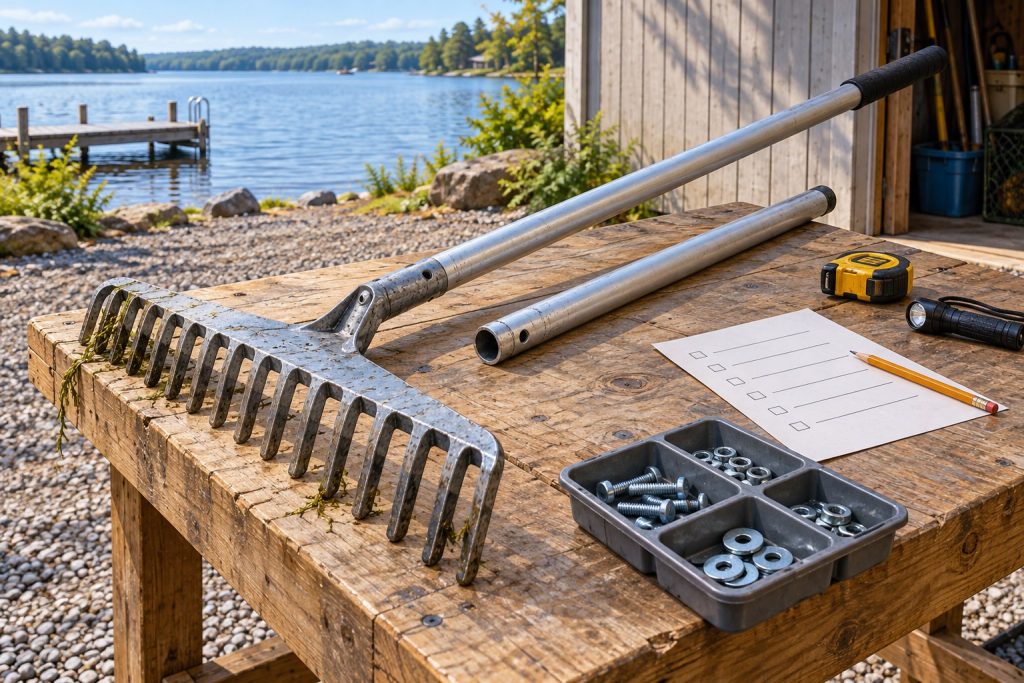
Ask to see the tool clean and fully accessible on dry ground. Keep cutting edges guarded according to the manual. Look at both sides of the head and follow the structure from its working end to the grip. Dirt, tape, and a neat paint job can all hide details you need to assess.
| Area | What to check | Reason to pause |
|---|---|---|
| Head and teeth | Alignment, cracks, missing pieces, unusual welds | Damage that changes how the load reaches the handle |
| Handle and joints | Dents, splits, movement, complete locking parts | A joint that will not lock or a repair of unknown quality |
| Blade and covers | Correct guards, secure mounts, damaged edges | Missing protection or uncertain replacement availability |
| Rope and attachment | Wear along the length and correct connection | Cuts, worn attachment points, or an unidentified substitute |
| Accessories | All parts shown in the correct manual | Missing pieces needed for safe assembly or storage |
The University of Kentucky hand-tool inspection guidance emphasizes keeping the manufacturer’s design intact and warns that tape is not an approved repair. Apply that principle to suspicious handles and modified connections: ask for the maker’s assessment rather than judging strength from appearance.
Do not bend a questionable head back into shape during the visit or perform a heavy pull to see whether it holds. A purchase inspection should reveal problems, not create an improvised load test.
Distinguish wear from a repair project
Scuffed paint may be a cosmetic issue. A crack at a joint is a different question. Surface rust may need assessment, while deep corrosion or missing metal can affect a part’s function. If you cannot tell, send clear photographs to the manufacturer or a qualified repair shop before agreeing to buy.
List each issue as one of three types: acceptable wear, a known repair with a quoted cost, or unresolved damage. Do not move an unresolved issue into the first group just because the price drops. A discount does not make an unknown structural repair safe.
Check whether the replacement is available now, not merely shown in an old manual. Ask for the part number, current price, delivery estimate, and any labor needed. A tool with a common bolt missing may be straightforward once the correct hardware is confirmed. An obsolete proprietary joint can be a much larger problem.
Give powered machines a separate inspection
For a powered cutter, conveyor, pump-driven system, or harvester, arrange a qualified inspection suited to that equipment. Ask the inspector to review the frame, drive system, controls, guards, electrical or hydraulic parts, and any trailer or flotation components. The exact list depends on the machine.
The CCOHS electric-tool safety guidance calls for checks of damaged cases, cords, plugs, switches, and batteries, and directs defective tools to qualified repair. Those checks illustrate why a powered purchase needs more than confirming that a motor turns on. They do not replace a machine-specific inspection.
Do not accept bypassed guards or defeated shutoffs as a convenient upgrade. Ask whether modifications were approved by the manufacturer and documented. An attachment that was homemade or adapted from another machine deserves particular scrutiny.
A demonstration should follow the manual and all site rules, with the seller or qualified operator in control. Do not stand near moving cutting parts or request a demonstration that skips guards. If an appropriate demonstration is not possible, keep the condition unresolved rather than improvising one.
Calculate the ready-to-use cost
Create a short cost sheet before negotiating. Add the asking price, confirmed replacement parts, professional service, transport, required cleaning or decontamination, and storage changes. Include accessories that are necessary for your work but absent from the sale.
For example, imagine a used manual tool offered for $120. Confirmed replacement parts cost $35, and pickup costs you $25. Your known total is $180 before any further repair. These are invented numbers to show the calculation, not current market prices. Compare that total with a new equivalent and with the value of its warranty and support.
Now add uncertainty separately. If the head joint has unexplained movement, do not hide that risk inside a small guessed repair allowance. Get a diagnosis and price or decline the purchase. A clear total with one unresolved safety issue is still an unresolved purchase.
The lake weed project cost guide helps place the tool purchase within the larger job, including collection, disposal, and repeat work.
Ask where the equipment last touched water
In a June 2026 notice about used water equipment, the Minnesota DNR reminded buyers and sellers to check for invasive species, clean equipment, and drain retained water. It also highlighted the state’s 21-day drying requirement for docks and lifts before placement in another waterbody. That specific rule should not be copied as a universal rule for every used tool.
Ask for the last lake or river, last use date, cleaning steps, and storage conditions. Check rules for the actual equipment and both locations before pickup. If attached organisms or plant material remain, ask the responsible agency how transport and cleaning should be handled.
The timing can affect the sale. You may need to delay pickup, arrange an approved service, or keep the equipment out of water. Settle who handles that work and its cost before payment. Do not let a seller’s wish for immediate removal decide the movement plan.
Set a clear accept-or-decline checklist
- The exact model is identified and its instructions are available.
- The tool fits the intended task and local approval.
- Required guards, connectors, and accessories are present or have confirmed replacements.
- Any repairs have an acceptable method and known cost.
- Recall questions and major modifications are resolved.
- The transport and invasive-species steps are clear.
- The full cost still makes sense compared with alternatives.
A seller does not have to be dishonest for a purchase to be a poor fit. They may have used the tool for a different plant, a wider work area, or a shorter season. Declining a mismatch is a useful result of the inspection.
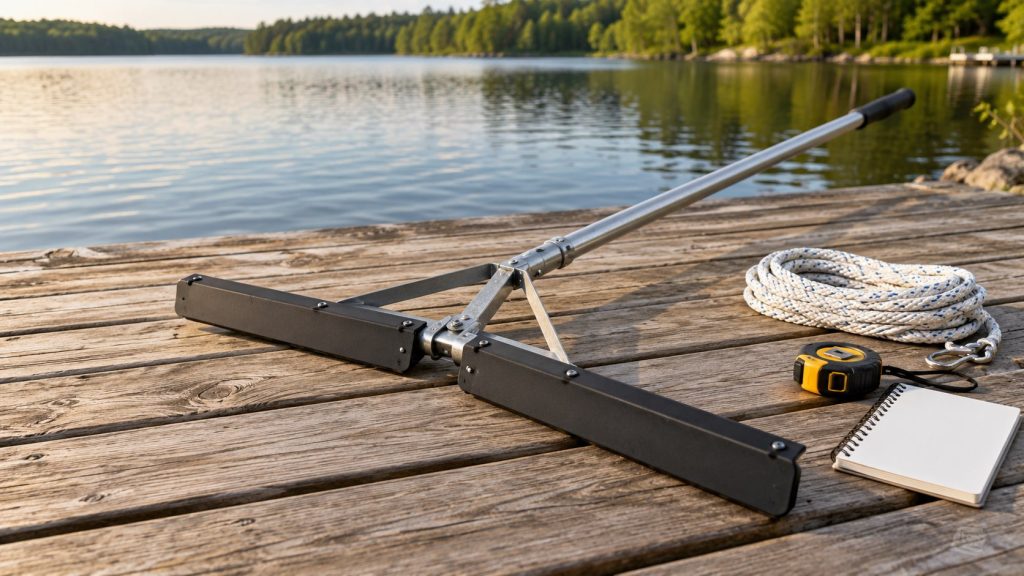
If a new manual tool better fits your approved task, review the T-Weeder Tool and order one for your permitted shoreline project. Compare its actual design and purchase terms with the complete used option, rather than comparing the new price with only a secondhand asking price.
For more equipment choices, browse the Lake Weed Tools guides.
Featured image: AI-generated illustration of a used-tool inspection on dry ground. Generic equipment and paperwork are shown; no tool is certified safe by the image.