Lake weed vs. seaweed is often a question of place and plant type. Learn how freshwater plants, large algae and tiny algae differ before choosing lake work.
Freshwater growth gets called seaweed, lake weed, pond moss, and lake grass. Those names help people start a conversation, but they do not tell you what is growing. A neighbor may use “seaweed” for any green strand that wraps around a paddle. A biologist may need a close view of the leaves before choosing even a broad group.
The useful question is not whether someone used the perfect word. It is what that word hides. A rooted plant, a drifting clump, and a bloom of tiny organisms can all affect the same swimming area. They call for different observations and different decisions.
Lake weed vs. seaweed: why the names overlap
Seaweed often brings ocean kelp and other large marine algae to mind. Yet everyday usage is broader and uneven. NOAA’s explanation of seaweed uses the common name broadly, including growth in rivers and lakes. This is a good reason not to treat the word as a precise scientific label.
“Lake weed” is also a loose name. It usually describes growth that a person notices or finds inconvenient. The word does not show whether the growth is native, invasive, rooted, floating, or even a true plant. A plant can be useful habitat and still be in the way at a particular landing spot.
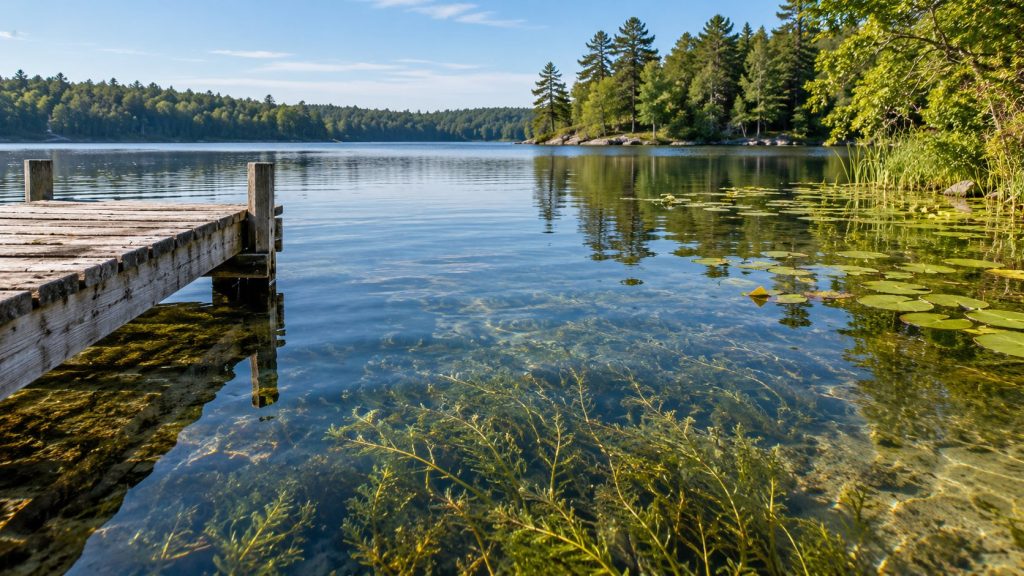
For a freshwater project, translate the loose name into a useful description. “Long stems with leaves under the dock” tells a helper more than “bad seaweed.” “Small separate green pieces drifting across the surface” points in another direction. You can give that description even before you know the species.
Freshwater contains plants and several kinds of algae
An underwater stem with leaves may be a flowering plant, even when no flower is visible. On the other hand, a green growth that looks like a small branching plant may be an alga. The Minnesota DNR algae guide explains that algae lack true roots, stems, and leaves. They range from tiny single cells to large forms such as Chara.
This distinction is about structure, not just size. Big does not always mean plant, and green does not always mean algae. Chara is a useful example because its upright shape can fool someone who expects algae to look only like floating slime. Its plantlike branches are not the same structures as the stems and leaves of a flowering plant.
For field notes, it is fine to write “branching growth; identity unconfirmed.” That is more useful than forcing a choice from a distant view. A broad group can guide the next question, but it should not become a species name through repetition.
Use growth form to organize what you see
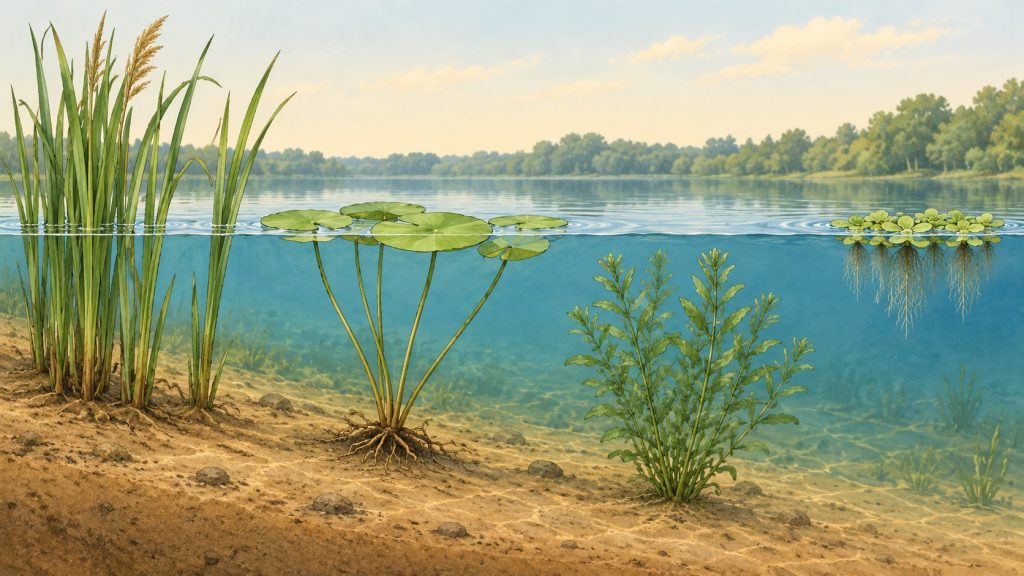
The Texas A&M AQUAPLANT identification guide sorts common pond growth into practical groups, including algae, floating plants, submerged plants, and emergent plants. These groups help narrow a search. They are not a rule that every underwater plant must have roots in the bottom.
| Observation | A useful first description | What remains unknown |
|---|---|---|
| Individual green pieces riding on the surface | Free-floating growth | Species, source, and whether several kinds are mixed |
| Leaves and stems mostly below the surface | Submerged plant growth | Exact species and whether the material is still growing there |
| Stiff stems standing above shallow water | Emergent plant growth | Species and the extent of its below-water growth |
| Threadlike material or a green mat | Possible algae or mixed growth | Identity and whether a harmful bloom may be present |
| Green water with no clear plant pieces | Possible tiny suspended organisms | Cause, species, and water safety |
Do not use this table to declare water safe or choose a treatment. Its purpose is to turn “seaweed everywhere” into a clearer starting note. If the growth is a plant, our lake weed growth-form guide explains the groups in more detail.
Seagrass shows why location is not enough
Ocean water does not make every green organism an alga. NOAA describes seagrasses as flowering plants with true roots, leaves, flowers, and seeds. They grow in shallow coastal waters. That separates them from the algae commonly called seaweeds.
Freshwater lakes also have underwater plants with long, narrow leaves. Similar shape does not make them marine seagrass. Nor does a ribbon-shaped leaf alone identify a freshwater species. The full plant and its growing setting matter.
This is where image searches can go wrong. A search for “lake seaweed grass” may mix coastal meadows, freshwater plants, aquarium species, and stock photos. Add the state or region and a feature such as “ribbon leaf” or “branched stem.” Then check an agency or university guide. For a local starting point, see lake weeds that look like grass.
A green surface is not one single problem
Some freshwater organisms are too small to recognize with the naked eye. Cyanobacteria are tiny bacteria often called blue-green algae. The EPA explains that cyanobacteria and green algae can look alike in dense growth, and some cyanobacteria can make toxins. A casual name such as “lake moss” does not settle that concern.
If water is scummy, discolored, or smells bad, keep people and pets out and follow local advice. Do not handle a suspicious mat to see what it feels like. The CDC’s harmful-bloom guidance says appearance alone cannot confirm whether a bloom could make someone sick; toxin testing is needed. Washed-up bloom material can also be a concern.
A rake or cutter is not a water-safety test. Removing visible material does not prove the water is safe afterward. If this is the main issue at your shore, use our algae-versus-plant guide to frame the next step.
Separate living beds from material that drifted in
A loose pile beside a dock can make a healthy-looking waterway seem full of new growth overnight. Before planning work, record whether you can see plants growing in place or only loose material against the shore. These are different jobs, even if the pile contains the same species as a nearby bed.
Think of two examples. At one dock, long stems stand in a broad patch beneath the water. At another, a narrow line of loose stems sits against the dock edge. Calling both “seaweed removal” hides the difference between managing a plant bed and collecting material that arrived there.
From a safe place, photograph the wider setting and note the date, water level, and recent wind. Do not drag an unidentified plant through the lake just to test whether it is attached. If you cannot tell, mark the question as unresolved. Your notes can help a local specialist choose a safe way to confirm it.
Turn a vague search into a useful request for help
When you ask an Extension office, lake manager, or service company for help, give them the problem and your uncertainty. You do not need to present a confident name. A short message with clear observations is easier to answer than a guessed diagnosis followed by a request for a particular treatment.
- Name the lake and region, and say whether the spot is a freshwater lake, river, or coastal inlet.
- Describe the growth: separate floating pieces, leafy stems, ribbons, threads, a mat, or discolored water.
- Say where it is: growing below the surface, standing above it, or piled along the shore.
- Explain the task: a blocked ladder, material caught on a paddle, or a concern about water contact.
- Include what you do not know, such as whether a loose pile came from a nearby bed.
For example: “At our freshwater dock, long leafy stems fill the space around the ladder. The water itself is clear. I do not know the species or whether the stems are rooted. What views would help you identify it?” That request creates a useful next step without claiming a diagnosis.
Read a “seaweed remover” listing by its actual job
A product title may use seaweed, pond weed, and lake weed to reach shoppers who use different words. Those words do not prove that a tool can handle every kind of growth. Look for what the tool physically does: cut stems, catch loose material, pull suitable plants, or carry a collected load.
Then compare that action with your problem. A tiny green film is not a stem-cutting job. A pile of loose vegetation is different from a bed anchored below the water. A tool that can reach a patch may still be awkward to lift when loaded. The listing needs to answer those practical questions.
Ask about reach, head size, control, retrieval, and the effort needed to use it from your shore. Read the instructions and the limits as closely as the name. If your identified growth and permitted manual task fit the product’s design, review the T-Weeder Tool and order one for your permitted shoreline project. Match it to that specific job.
Keep the name, evidence, and decision separate
A simple three-line note can prevent confusion when several people discuss the lake. On the first line, write the everyday name used: “seaweed by the dock.” On the second, write the evidence: “leafy stems visible below the surface; species unconfirmed.” On the third, write the next decision: “ask for identification before choosing a method.”
Later, replace the uncertain description with the confirmed name and the source of that identification. Keep the earlier photograph so you know which patch was reviewed. If a different kind of growth appears next month, open a new note instead of assuming the old answer applies.
The goal is a useful conversation about the actual growth. Freshwater or saltwater is part of the setting. Plant or alga is part of its structure. Species, location, and the task then guide the choice. Browse our aquatic plant identification articles when you are ready to narrow that starting description.
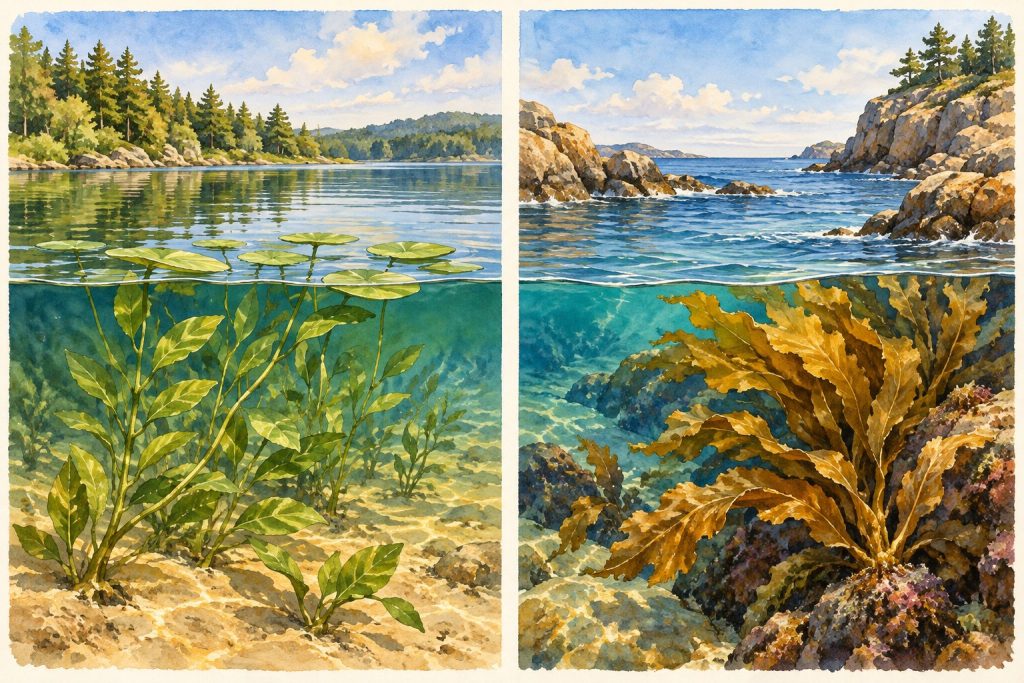
Featured image: AI-generated illustration comparing freshwater plant growth with coastal algae. It shows broad concepts, not verified species or a field identification key.