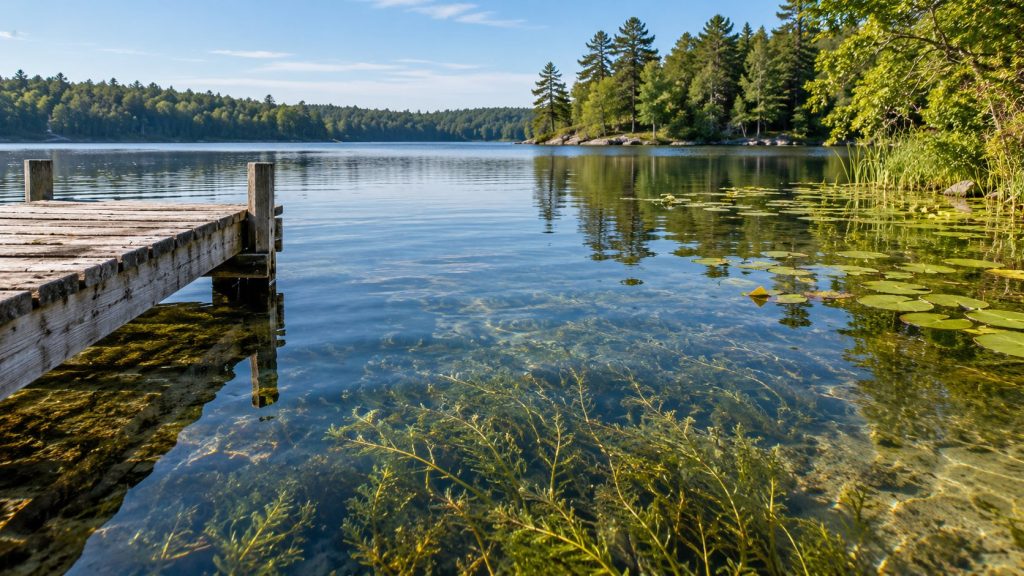
Lake weed identification helps you compare common aquatic plants, spot invasive look-alikes, and plan responsible weed removal around your shoreline. Understanding what grows beside your dock is the first step toward a practical plan. A feathery underwater stem, a ribbon of grasslike leaves, and a green surface mat can represent very different organisms. Knowing the difference helps you protect useful habitat and choose a sensible next step.
This guide covers ten common aquatic plants and algae that lake owners may encounter, with an emphasis on Minnesota and the Upper Midwest. You will learn which features to photograph, how to compare confusing look-alikes, and why identification should come before removal. The linked agency guides provide real reference photos and drawings to check against your observations.
T-Weeder began with a Minnesota family’s efforts to improve their lake swimming area. You can read the story behind T-Weeder. That lakeshore perspective shapes this guide: start by understanding the plants, then decide what your particular access area needs.
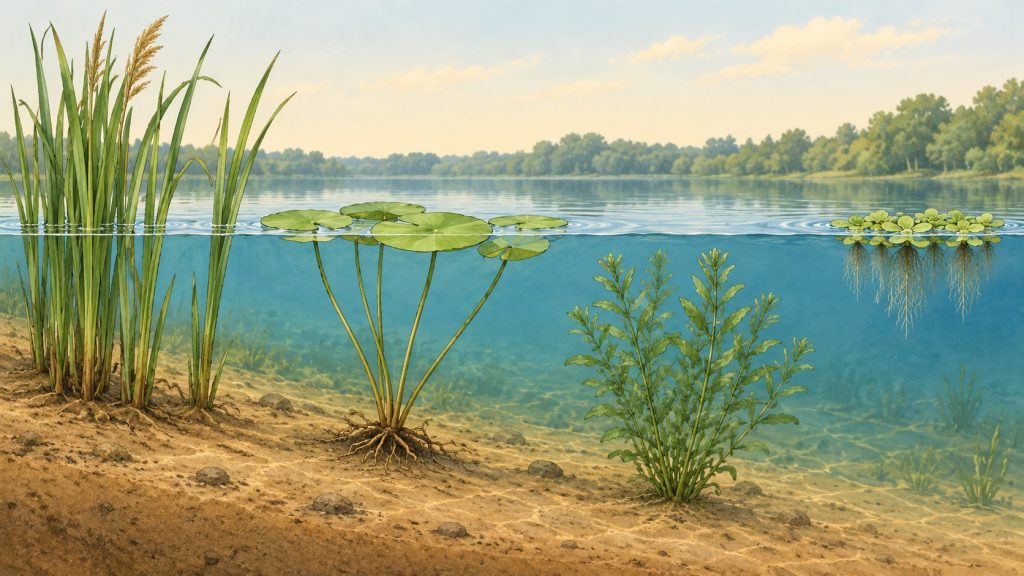
Featured image: AI-generated editorial illustration. Use the linked reference photos for plant identification.
Start lake weed identification with the growth pattern
First, step back from the individual leaf. Where does the plant grow, and how does it sit in the water? This simple distinction narrows the possibilities before you compare species. The Minnesota DNR’s aquatic plant overview explains the major growth forms and their importance to lake habitat.
- Submerged plants: Most of the stem and foliage grow underwater. Coontail, watermilfoils, and many pondweeds fit this group.
- Rooted floating-leaf plants: Leaves rest on the surface while stalks connect to roots below. Water lilies are a familiar example.
- Free-floating plants: Small plants drift at the surface rather than rooting into the lake bottom. Duckweed belongs here.
- Emergent plants: Roots sit in shallow water or wet sediment, while stems and leaves rise above the surface. Cattails and bulrushes are examples.
- Algae: These lack true roots, stems, and leaves. Some form threads or mats; others, including chara, resemble branching plants.
Treat this as a sorting step, not a final answer. A single patch can contain several species, and a loose fragment may have drifted from elsewhere. For pond weed identification, the same approach works, although the likely species change with location and climate.
Build a useful aquatic weed identification record
A distant picture of a green patch rarely captures enough detail. Instead, make a small photo record that shows both the setting and the features you want an expert to examine. Keep the observations attached to the photos so you do not have to reconstruct them later.
- Record the location. Note the lake name, state, date, and approximate position near your shoreline or dock.
- Photograph the whole patch. Include a fixed landmark and describe whether the growth is underwater, floating, or above the surface.
- Show the leaf arrangement. Look for leaves that alternate along the stem, appear in opposite pairs, or radiate around one point in a whorl.
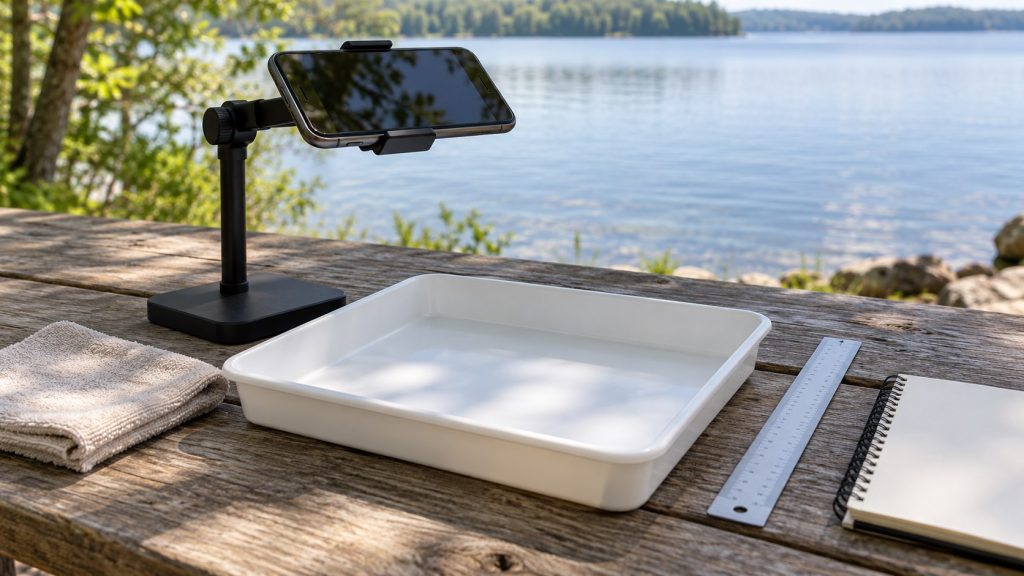
- Capture fine details. A close photo should show leaf edges, forks, veins, and any flowers or reproductive structures. Include a ruler if you can do so without disturbing the plants.
- Note what remains uncertain. A tentative identification is useful when you also record the feature you could not see.
If you already have a legally collected sample, keep it in a shallow tray of water while you examine it. This helps delicate leaves spread out. Ask the appropriate agency before collecting or transporting unfamiliar plants, especially suspected invasive species. For a more detailed comparison, use the University of Minnesota’s aquatic invasive species identification guide, which includes native look-alikes.
Lake weed identification guide: 10 common plants and algae
Use the descriptions below to choose a likely match, then compare several features with the linked reference. Common names can vary, so the scientific names are included where they help. A plant’s appearance alone does not establish whether removal is appropriate or permitted.
1. Coontail: forked leaves and a bushy tip
Coontail (Ceratophyllum demersum) often resembles a narrow bottlebrush beneath the water. Its dark green leaves are stiff and forked, with a spiny appearance. Growth can be especially dense toward the stem tip. Unlike many submerged plants, coontail has no true roots.
The useful comparison is with milfoil. Coontail’s leaves divide into forks; milfoil has fine segments arranged along a central leaf axis, like a feather. Coontail also provides cover for young fish. If dense growth interferes with access, identify it before deciding how much needs attention. Compare your photos with the DNR coontail guide.
2. Eurasian watermilfoil: finely divided featherlike leaves
Eurasian watermilfoil (Myriophyllum spicatum) is an invasive submerged plant in Minnesota. Its leaves usually form whorls of four around the stem. Each featherlike leaf typically has 12–21 pairs of fine leaflets. The leaves tend to collapse when lifted from the water, and the stems may look pale, brownish, or reddish.
However, color alone is unreliable. Count leaflet pairs on several developed leaves and compare the overall structure. Plant fragments can establish new growth, so avoid casually cutting apart an unknown milfoil patch. The DNR Eurasian watermilfoil profile provides identification details and reporting guidance.
3. Northern watermilfoil: a native milfoil look-alike
Northern watermilfoil (Myriophyllum sibiricum) is native and also has feathery leaves arranged around a stem. It commonly has 5–10 leaflet pairs per leaf. Compared with Eurasian watermilfoil, its leaves tend to hold their shape better out of water. It also forms compact winter buds.
These features help explain why every feathery plant should not be labeled an invader. Start with the DNR northern watermilfoil reference. If the traits seem mixed, request expert confirmation: University of Minnesota research also documents hybrid watermilfoil. A leaflet count is a screening clue, not a guarantee that you have resolved every milfoil identification.
4. Curly-leaf pondweed: wavy leaves with toothed edges
Curly-leaf pondweed (Potamogeton crispus) has narrow, oblong leaves with strongly rippled edges. Look closely for fine teeth along those edges and a blunt leaf tip. Leaves attach directly to the stem in an alternating pattern. The plant can appear olive green or reddish brown.
Its seasonal pattern supplies another clue. In Minnesota, it starts growing early and commonly dies back in midsummer. It also produces firm resting buds called turions. Because native pondweeds can have wavy leaves too, inspect the edges rather than relying on the ripple alone. See the DNR curly-leaf pondweed profile for reference images and current guidance.
5. Broad-leaf pondweeds: check how the leaf meets the stem
Native broad-leaf pondweeds include several species, so this name describes a group rather than one plant. Their leaf shapes and growth forms vary. Some produce floating leaves, while others keep most foliage below the surface. Strong stems and visible leaf veins can help you recognize the group.
Clasping-leaf pondweed is particularly easy to confuse with curly-leaf pondweed. Its broad leaf base wraps partly around the stem, and its wavy leaf edges lack the small teeth found on curly-leaf pondweed. Native pondweeds provide valuable habitat; identifying the species matters before clearing a patch. Compare the DNR broad-leaf pondweed examples.
6. Canada waterweed: small leaves around branching stems
Canada waterweed (Elodea canadensis) has branching underwater stems with small, simple leaves arranged in clusters around them. The DNR describes clusters of three or four leaves. These clusters often sit closer together at the tips and farther apart lower on the stem.
Unlike milfoil, the leaves are not divided into featherlike segments. Canada waterweed can form dense growth near the bottom, and its brittle stems can break into fragments. A sample with several intact stem sections is more useful than a single detached leaf. Use the DNR Canada waterweed guide to compare the leaf shape and arrangement.
7. Wild celery: long ribbons rising from the bottom
Wild celery (Vallisneria americana), also called tapegrass or eelgrass, has long, unbranched, ribbonlike leaves. They rise from the lake bottom rather than branching off an upright leafy stem. In late summer, a coiled flower stalk can provide an additional clue.
This native plant offers food and shelter for wildlife. The DNR generally recommends leaving it alone because of that value. If you see underwater ribbons, trace their growth pattern visually before calling them a narrow-leaf pondweed or an unwanted grass. The wild celery reference shows the features worth comparing.
8. Duckweed and watermeal: tiny floating plants
A smooth green blanket on a sheltered bay may consist of tiny floating plants. Duckweed has small green bodies called fronds, often with roots dangling below. Watermeal is even smaller and resembles green grains; it has no roots.
The main comparison is with filamentous algae. Duckweed consists of separate little plants, whereas filamentous algae forms connected strands. Look closely at the individual units instead of judging the whole mat from the dock. The DNR duckweed and watermeal guide explains both forms. Their floating growth also means a tool intended for rooted vegetation may not match the problem.
9. Filamentous algae: threads rather than leaves
Filamentous algae forms long, hairlike strands that can tangle into floating mats. Depending on the type and condition, it may appear slimy or cottony. Growth can begin on the bottom, rocks, or other vegetation before rising toward the surface.
Look for the absence of recognizable leaves and leafy stems. This separates the basic growth form from pondweeds, although it does not identify every kind of algae. Nuisance growth can relate to excess nutrients, so removal alone may leave the underlying conditions unchanged. Read the DNR filamentous algae overview before choosing a management approach.
10. Chara: algae that looks like a small plant
Chara, often called muskgrass or stonewort, resembles a branching underwater plant but is a form of algae. Its branchlets radiate around the main axis. Mineral deposits can give it a gritty feel, and it can produce a strong musky odor when crushed.
For lake weed identification, its main lesson is that a plantlike outline can be misleading. Chara can resemble coontail, milfoil, and other large algae. Use the DNR chara guide to compare the whole structure. Do not use texture or odor by itself to decide that an unfamiliar patch is native.
Watch for invasive look-alikes before removing lake weeds
Starry stonewort deserves special attention because it can resemble native chara and other large algae. Its most distinctive feature is a tiny white, star-shaped bulbil on clear, rootlike threads near the base. These reproductive structures are often easier to find in late summer. Their absence from a quick photograph does not rule out the species.
If you suspect starry stonewort, document the location and contact an aquatic invasive species specialist. Avoid moving material to another waterbody. The DNR starry stonewort profile includes close-up references and reporting instructions.
| Possible confusion | Feature to compare |
|---|---|
| Coontail vs. watermilfoil | Forked, spiny leaves versus featherlike leaves with a central axis. |
| Northern vs. Eurasian watermilfoil | Several leaflet counts, leaf form, and expert review when traits overlap. |
| Clasping-leaf vs. curly-leaf pondweed | Leaf bases and finely toothed edges, rather than waviness alone. |
| Duckweed vs. filamentous algae | Separate floating fronds versus connected threads. |
| Chara vs. starry stonewort | Examine the basal structures; seek confirmation of suspected star-shaped bulbils. |
Turn lake weed identification into a practical next step
Once you have a likely match, define the actual problem. Does the plant block a narrow boat route, crowd a swimming entrance, or simply grow where you can see it? Write that goal down before selecting equipment. A small, specific access goal is easier to evaluate than a general wish to remove every green plant.
Next, separate identification from treatment choice. Rooted plants, rootless submerged growth, floating plants, and algae call for different assessments. Also consider whether fragments can spread, what habitat you would disturb, and who can confirm your plan. The DNR aquatic plant questions and answers explains why recurring maintenance may be necessary and why a completely vegetation-free shoreline is often unrealistic.
Check Minnesota removal requirements first
Minnesota’s rules depend on the plant group, method, and location. The DNR lists emergent-plant destruction, herbicide use, and several other activities as requiring permits. Limited manual removal of submerged vegetation may qualify for an exemption, but the limits and conditions matter. Consult the current aquatic plant management guidance and confirm your specific situation before starting.
Do not assume a small-area exemption authorizes work on an invasive infestation. The DNR’s invasive aquatic plant management program states that mechanical removal or herbicide management of invasive aquatic plants in public waters requires a permit. Outside Minnesota, consult your own state or local authority.
Finally, plan how you will contain removed material and clean equipment. Transportation can have separate requirements; check the DNR aquatic plant transport guidance before taking vegetation elsewhere. That planning belongs alongside equipment selection, not after a pile of plants is sitting on the dock.
Lake weed identification FAQs
Can I identify lake weeds from a photograph?
Sometimes a clear photograph can narrow the possibilities substantially. However, one view may hide the feature that separates two species. Send an overview plus close-ups of leaves, attachment points, and any reproductive structures. Include the lake and date. When the match affects invasive-species reporting or removal, ask a qualified local specialist to confirm it.
Are all underwater weeds invasive?
No. Coontail, northern watermilfoil, wild celery, and many pondweeds are native in Minnesota. They can grow densely and still serve useful ecological roles. Invasive status is not the same as nuisance growth, and a plant’s status can differ by region. Use a regional reference rather than assuming that a generic internet label applies to your lake.
Why do aquatic weeds return after removal?
The reason depends on the organism. Some plants regrow from surviving parts, some spread through fragments or resting buds, and floating growth may move back into an area. Favorable conditions can also support more growth. Record what returns and when; that evidence helps distinguish an identification mistake from a management method that needs adjustment.
What is the best tool for removing lake weeds?
There is no single tool for every species and setting. First confirm the plant, your access goal, and the applicable rules. Then compare equipment designed for that type of work. Review the T-Weeder tool details to assess its fit for your project. A product choice should follow the identification and site assessment.
Make your next shoreline check more useful
On your next visit to the dock, choose one patch and record its growth form, leaf shape, and location. Compare it with the official references linked here. If the features do not line up, keep the identification tentative and seek help. Careful lake weed identification gives you a clearer starting point for maintaining access while respecting the living shoreline around it.
Ready to plan your next step? Use our shoreline removal plan, compare features in the lake weed rake buying guide, or read the questions to ask before herbicide treatment.
If you need to sort a plant before narrowing its species, use the lake weed growth-form field guide.